Thursday, 6 October 2016

West Coast media trip: part 2


The dust brought up the rear as the two buses came to a halt outside the furtherest buildings on Klein  Namaquafontein, one of the farms making up the Moutonshoek Protected Environment. The reader is directed to the previous blog to find out the circumstances which brought this small farming community together to protect the single aquifer which provides water here, to Verlorenvlei and to Elandsbaai on the coast.

We disembarked and were met by David and Charlene Rothquel. I milled about, passed scattered conversations and looked for the best place to stand. 
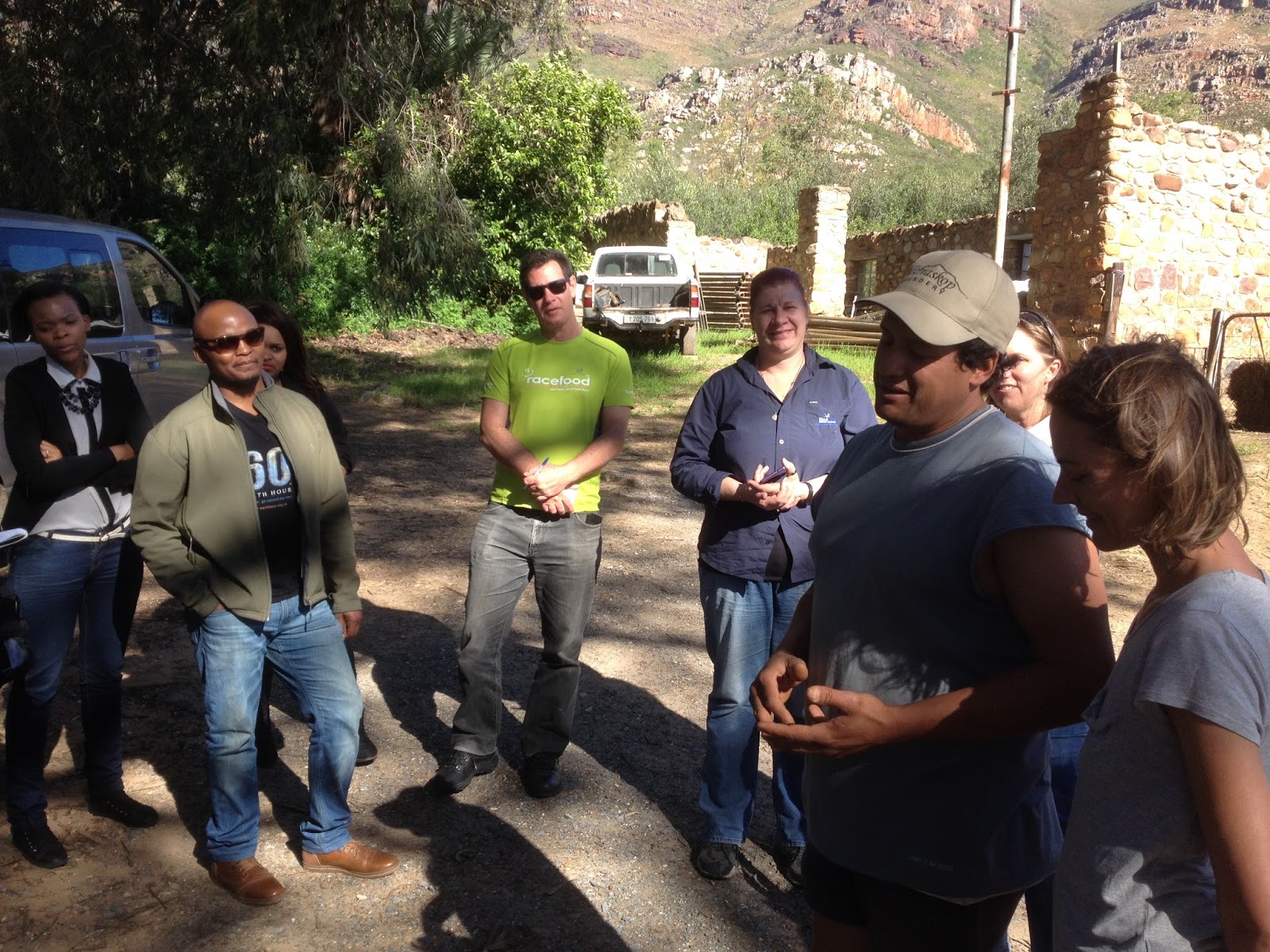
The Rothquels address us.
 The Rothquels spoke at length about their farming activities. This hard-working couple run a mixed operation, farming organically. Olives, lavender, buchu are included amongst the products which come from here. A past fire had destroyed much of the infrastructure but things had since picked up and they have bought the farm. 

Among the party that joined us on the farm was one Goldie Weideman. I cannot say that she contributed to the discussions that followed, but she stayed with us for the whole afternoon, occasionally bumping into people, drawing looks, smiles, comments and chuckles but never smiling herself. Goldie Weideman has no idea that she is a sheep. 


Goldie Weideman makes our acquaintance


We were invited to see the farm and so we set off.


Crossing streams ...
Climbing closer to the mountains and a view ...

Smelling the flowers - in this case, buchu (Agathosma betulina). Indigenous to South Africa, this shrub can be harvested for medicinal purposes.

Beehives could be seen intermittently. Remarkably, they have recovered on their own from American Foulbrood (no human intervention was required).
 
Standing underneath the leopard tree


At the furtherest point of our walk, we paused at a tree used as a scratch pad by passing leopards. After this I thought I noticed a  surreptitious look or two cast around by the party. 

Farmers respond to the leopards by keeping their flocks away from areas at the foot of the mountains, and bring livestock back to buildings and kraals at night.
  

The impressive couple would not let us leave without each of us receiving a gift of both olive- and essential oils. 


We passed neighbouring farms, one on which thoroughbred horses are bred, before pausing at a clearing where alien invasives have been weeded out, part of the Krom Antoniesrivier LandCare Project. Advantages from controlling alien vegetation are ecological and economic: less water lost, jobs created. A previous blog covers work done in this regard by the WWF Nedbank Green Trust.

Surveying the work done in removing invasive alien plants.


And then we were on the R366, travelling west, travelling parallel to Verlorenvlei, the Ramsar-proclaimed wetlands and one of the few coastal fresh water lakes in the country; travelling mostly in silence while heaven and earth became one syllable. 

At the Elandsbaai Hotel we were shown our rooms and got ready for the evening. 

Thursday, 29 September 2016

West Coast media trip: part 1


In the week when farmer association KwaNalu reported that there were thousands of oil and gas exploration applications to prospect on KwaZulu-Natal farmland (FW 23 Sept 2016), a group of journalists and team assembled by the WWF Nedbank Green Trust were looking at how the possibility of a tungsten mine spurred a group of farmers to have their area classified as a Protected Environment.


Most people enjoy a break from the routine, especially if it involves travel. When the invitation came from the WWF Nedbank Green Trust to accompany a contingent of journalists and others to the West Coast, I put my hand up and the morning of the 21st September found me in one of two silver Hyundai buses pointing north from Cape Town.

 The reader will appreciate that names like Moorreesburg, Piketburg and the Sandveld in the Western Cape have long been linked to agriculture, and during our years of compiling the agricultural publication those names have become very familiar: a group of farmers started the co-operative called Moorreesburg Koring Boere (Moorreesburg Wheat Farmers), now part of a larger agribusiness; the Sandveld is renowned for its potatoes and the conservation efforts that go with protecting its ecosystem; agricultural training providers Praktika are based in Piketberg ...

The notice of proposed mining activity in Moutonshoek, just north of Piketberg, was enough to get landowners of the area together. The alarm bells were heard in wider conservation circles and led to the involvement of Birdlife South Africa and the Wildlife andEnvironment Society of South Africa (WESSA), backed by the WWF Nedbank Green Trust.

Moutonshoek is the catchment area supplying the Krom Antonies River, which widens through wetlands, leading to the estuary at Elandsbaai on the West Coast. The wetlands are a Ramsar proclaimed site, and an Important Bird and Biodiversity Area (IBA) too, with significant populations of threatened and migratory bird species included amongst the 200 plus bird species it hosts. Also to be counted in the biodiversity of the area are the IUCN Red-listed Verlorenvlei Redfin fish (Pseudobarbus verloreni), the Endangered Diascia caitliniae, and the Critically Endangered Redlinghuys Pincushion (Leucospermum arenarium), and looking on from the mountains, the Cape Leopard. Add to this biodiversity the population of Elandsbaai, very dependent on the single aquifer under Moutonshoek and the reader will appreciate what brought farmers, conservationists and others together.

If land is as vital as the Mountonshoek-Verlorenvlei area, then there is a need to gear up from a simple conservancy to something with a bit more clout. (To see what the four Biodiversity Stewardship options are, refer to heading 5 of the "Biodiversity and ecosystems services" chapter of the Agri Handbook or click here).

After consultations, the farmers in Moutonshoek decided to go for Protected Environment status and signed a Memorandum of Understanding with Cape Nature, the provincial nature agency, to declare the intention to pursue the Biodiversity Stewardship model for the area.


At the turnoff to Moutonshoek we piled out of the buses to read the notices and to get the feel of the place. 

Monday, 19 September 2016

Announcement: 16th Annual South African Agricultural Outlook Conference

Are you ready for a thought provoking experience? The annual AMT Agri-Outlook Conference is not to be missed and remains one of the highlights on the South African agricultural calendar.

The CSIR International Convention Centre. Photo used courtesy of www.csiricc.co.za.


The 16th AMT Agri-Outlook Conference will be held on 28 September 2016 at the CSIR International Convention Centre in Pretoria. 

The theme of this year's conference is: Politics, conflicts, global warming, the world economy and the future of agriculture in South Africa. Producers, producer organizations, banks, universities, government officials, agri businesses and the media will attend. This is an excellent annual networking opportunity for all role-players involved in agriculture.

Some of the renowned speakers will be Mr. Mike Schussler, who will give an economic outlook for 2017, and Mr. Johan van den Berg who will discuss the climate outlook for 2016 and 2017. Mr. Van den Berg will give his opinion regarding rain expectations for the coming summer. Another world class speaker, Mr. Theo Venter, will present a political outlook for 2017 which will be interesting following the outcomes of the local municipal elections in August 2016. Mr. Chris Hart will share his insights in terms of the impact of policy on the economic and agricultural economic environment while Mrs. Chantell Ilbury will elaborate on the flags which indicate an increase in global conflict and what this means for Agribusiness in South Africa.

During the panel discussion the opportunity will arise for interaction between the audience and experts in their field. This year the panel of experts, which includes Prof Nick King, Dr Andries Jordaan and Mr. Christo van der Rheede, will focus on issues regarding risk mitigation within the context of climate change, water and food security as well as drought mitigation strategies and drought relieve in South Africa.

The Global and South African Outlook for the supply and demand of grains, oilseeds and livestock will be addressed by Mr. Ernst Janovsky with final perspectives on the day's deliberation that will be dealt with by Dr Herman van Schalkwyk.

The day's programme will be concluded with a gala dinner with guest artists (It Takes Four) and a lucky prize draw. This conference will provide you the opportunity to listen, experience and interact with the experts and leaders in the agricultural business environment. If you are interested in attending this conference, or want to sponsor, exhibit or advertise in the conference programme booklet, contact Mrs. Dalene Coetzer at 076 188 6533 or e-mail liaison [at] amtrends.co.za.

Find more information here.

Tuesday, 16 August 2016

Announcement: 2016 Toyota New Harvest of the Year Competition

Dear sir/madam

This is a reminder to enter the Toyota New Harvest of the Year Competition 2016 as we are nearing the closing date at the end of next week.  Thanks to all the companies/organisations that already entered a candidate(s) for the competition, and those who have forwarded the entry forms and -details to other relevant people/organisations and possible candidates.

 Remember that the objectives of this competition are:
  1. to identify and reward the most successful previously disadvantaged (black/Indian/coloured) farmer in South Africa, and;
  2. to provide credit/recognition to those people/institutions/organisations/agencies that are involved in the development of new farmers.
The winner will receive the prestigious “2016 Toyota New Harvest of the Year” trophy and a Toyota Hilux bakkie. The nominating agency will receive a cash prize of R10,000 from Toyota SA which could be used for the development and assistance of more HDI (Historically Disadvantaged Individuals) farmers.

By participating the nominator and finalist will receive much publicity.  All that is required from you is to identify and nominate such a successful farmer with whom your institution assisted in the development of the individual.  Please ask your candidate to complete Section A of the attached entry form where after you must complete Section B and return both sections by fax to +27 (0)51 507 4060 or +27 (0)86 503 6166, or send the scanned entry form by email to cvdwesth [at]cut.ac.za or post to Prof. C. van der Westhuizen, Department of Agriculture, Central University of Technology Free State, P/Bag X20539, Bloemfontein, 9300.

The entry requirements, procedure and adjudication criteria are included in the entry form – please read it carefully.   However, please do not hesitate to contact me at any time at +27 (0)51 507 3788 or +27 (0)83 445 2662 if you have any queries or need any special arrangements.

I am looking forward in receiving your entry/entries before or on 26 August 2016.

Kind regards

Prof. Carlu van der Westhuizen

Convener/chairperson of the panel of adjudicators

Monday, 11 July 2016

The Agri Handbook 2016/17 edition can be accessed from today

The Agri Handbook is available to the general public, online, as of today. Ninety chapters out of the 180 can be accessed at www.agribook.co.za, or click here.

It is still very much a work-in-progress. More chapters will be added on a weekly basis. Many of these, up-to-date last year, require revision. We will allow a few days to sort out teething problems before alerting the wider agricultural community, inviting it to visit the website which gives an overview of the entire agricultural value chain.

If you notice anything that you wish to query, or if your advert is not showing correctly, or if you have feedback of any sort please leave a comment or drop me an email.

Friday, 8 July 2016

The Agri Handbook for South Africa 2016/17

The first 90 chapters of the 2016/17 Agri Handbook for South Africa will be live on a sister website, to be announced on Monday 11 July. Further chapters will be added on a weekly basis.

The current book, in English or in Afrikaans, can be downloaded free as a pdf (find this option under “Order”). The 2016/17 edition will be different, in that it will be readable as internet site. You will be able to scroll down on “Infrastructure”, for example, and click on “Irrigation” and the chapter will be there, immediately accessible.

We are very excited about this venture, and invite you to visit us on Monday to view it for yourself.

For visitors new to the publication, the Agri Handbook covers the whole agricultural value chain in South Africa. Clicking on “Table of contents” will give you an idea of the range.

Thursday, 23 June 2016

More of the brown, less of the green: putting water into our "water factories"


                                                     A media trip to the Western Cape Part III

Photograph used courtesy of Helen Gordon, WWF SA

“So we want more of the brown, less of the green?” asked one member of the audience. She was responding to a slide of two people, one standing on brown veld and the other on “lush” greenery (see photo above). The problem with the latter was that the budding greenery was that of a fresh invasion of Invasive Alien Plants (IAPs). The brown was an area that had been treated and subsequently regained its health.

IAPs are not a serious contender for what grabs our attention. We might have a vague idea that invasives have to go, but our buy-in doesn’t go much beyond that. When informed, though, that water lost to invasive alien plants is estimated at an annual 1.44 billion cubic metres nationally we might start paying attention. This volume could sustain 120 000 hectares of crops to increase food production, or supply 3.38 million households of four members for one year.
 
Helen Gordon has done the maths, and her presentation on the first evening of the media tour was certainly food for thought. Gordon is Programme Manager for the WWF Water Balance Programme.

The recent drought’s deleterious effect on agriculture and the economy would show to any observer the importance of water. If you regard water as coming from a tap and have never gone beyond this, then this article will hold little interest to you.

The expense of keeping water in those taps is enormous. R1.4 billion per year is required just to keep existing water infrastructure ticking over. A further annual amount of some R63 billion is called for to upgrade what we have in order to meet the projected demands. And when the rains don’t come, that water supply is threatened before it gets close to our taps.

But investment also needs to go into our ecosystems, what WWF calls “the water factories”. Without functioning ecosystems it doesn’t matter how much is spent on dams and the other water infrastructure!

The Water Balance Programme, through its IAP clearing projects, puts “new” water into freshwater ecosystems. It is an important water supply intervention. A background to IAPs in the country:

  • IAPs destroy the proper functioning of wetlands (vleis in South Africa) and the plant habitats and communities along the river margins (riparian zones). The ecosystem services provided by these ecological bulwarks are lost to us.
  • IAPs have invaded a total area of some 18 million hectares in the country. Indigenous vegetation cannot compete with them and so the natural balance becomes out of kilter and biodiversity is lost.
  • Working for Water is the government response to IAPs. Some 2.7 million hectares have been treated over the past two decades with some R800 million being spent every year. Clearing is costly and requires on-going commitment. 

The next article will deal with the first stop the following day, a look at how the Water Balance Programme saves water, infrastructure (pumps, bridges) and creates jobs.