Thursday, 2 February 2017

The future of land reform in South Africa – the next 15 years

Land Reform Futures Scenarios bring a fresh perspective and new hope on discussions on land reform - a press release

As pressure mounts for the acceleration of the land reform programme, stakeholders in land reform held a roundtable session this week to discuss possible scenarios.

The roundtable was hosted by the Vumelana Advisory Fund, a non-profit organisation that helps beneficiaries of the land reform programme put their land to productive use by establishing commercially viable partnerships between beneficiary communities and investors. The roundtable was attended by representatives from the media, from AgriSA, the Department of Rural Development and Land Reform, the African Farmers’ Association of South Africa, the European Union and the Bela Bela Communal Property Association (CPA). 


Discussions focused on four land reform scenarios that can possibly unfold in South Africa over the next 15 years: 
  1. Connection & Capture; 
  2. Market Power & Concentration; 
  3. Occupation & Confiscation; 
  4. Hard Bargaining & Compromise. 
The Land Reform Futures or Scenarios were developed over a period of two years by 40 people who approach land reform from widely differing perspectives: policy makers and administrators, traditional leaders, communal property institution leaders, activists, business people, academics and consultants. 

Speaking at the roundtable, Brian Whittaker, director and strategy advisor at Vumelana Advisory Fund explained that the scenarios are not predictions or proposals. They merely provide a perspective on how things can possibly pan out. 

“The scenarios are not exhaustive, but tell stories about how South Africans might respond to the challenges and what the outcomes of their responses can be,” he said. “In the case that one scenario is applied, it provides insights on what could possibly happen as a consequence to that scenario, and this speaks to the economic and social perspectives.”

The scenarios can be used by any institution as a reference point in planning around land reform. They present an inclusive and structured way in which to look at what could possibly happen and can therefore help with decision-making and planning in the land reform space, he added.
  • Scenario 1, Connection and Capture, paints a picture of what can happen should government allocate land arbitrarily to shore up support ahead of the 2019 elections. Such a move is likely to benefit the politically connected to capture land reform for their own purposes.
  • Scenario 2, Market power and Concentration, describes what can happen should government decide to accelerate land reform through community-private partnerships. Such a move would lead to a substantial transfer of commercial farmland to black South Africans, but would not necessarily bring about the necessary reform; it would change ownership, but not the structure of agriculture.
  • Scenario 3, Occupation and Confiscation, describes what can happen if South Africans opt for land invasion in the face of deepening hardship.
  • Scenarios 4, Hard bargaining and Compromise, describes what can happen if South Africans agree to equitable land sharing. In such a scenario, land reform would become a shared responsibility among a wide range of actors, supported by an enabling state that is committed to pro-poor land and agrarian reform.
“Scenario 4 presents an ideal approach,” Annelize Crosby, AgriSA’s legal and policy advisor, said at the roundtable. “However, there is still need for engagement on it.  The hard bargaining and compromise process leaves the country with no choice but to engage. To say we are going to expropriate 70% of land within a year or two is extremely disruptive – if it happens within the next two years, it will be very disruptive indeed.” 

Crosby believes that the right frameworks are in place, though people within these frameworks may not be truly empowered. “While having land reform committees is a good concept, the way in which it is being rolled out is not perfect,” she noted. “Certain interventions must be made by national government, and that’s not only on land - there has to be an understanding of what people want. In some cases, people just want their lives to be improved, they want a better life for their children, and this may or may not include land.”

The majority of participants at the roundtable supported the view that the fourth scenario presents a plausible solution to addressing some of the current land reform challenges. Aggrey Mahanjana, secretary-general of the African Farmers' Association of South Africa believes that a combination of scenarios four and two will help South Africa achieve the target of one million jobs in agriculture by 2030.

“Scenario 4 will contribute towards the development of the country without messing up the country, however there needs to be a clear framework of implementation in applying these scenarios,” he noted. “And we need to make sure that partnerships are not skewed where our people are ripped off. Government has to intervene to make sure that we strike a proper balance in terms of policy to make sure that both parties involved in the partnerships benefit.”

Elton Greeve, chief director of strategic land reform interventions at the Department of Rural Development and Land Reform highlighted that many people don’t fully grasp land reform’s economic and social consequences. 

“They see land reform as acquiring land and distributing it,” he pointed out. “While that’s an element of land reform, it is a small element; there are economic and social impact issues and other elements. We need to have the right framework and get people to understand that there is a difference between redistribution and restitution, as this deals with different elements.”

According to Greeve, government cannot resolve land reform on its own, there is a need for partnerships. “It’s encouraging to see that the 80 partnerships that have been formed with white farmers, are voluntary partnerships.  We have farmers now coming up to say we want to partner, help us to do it. We need more of this kind of non-coerced partnerships.”

For more on the Land Reform Future Scenarios, visit www.landreformfutures.org

Tuesday, 24 January 2017

Davos and a reference point for 2017


With inequality lurching wider every day, the middle class thinning out, one percent of humanity as wealthy as all the rest put together etc, one cannot but give a slight frown when viewing a gathering such as that of the annual World Economic Forum (WEF) at a ski resort in Switzerland earlier this month.

Davos 2017 is over. For several days articles and blogs have surfaced about the event and will continue to do so as the year proceeds apace.


In preparation for the annual event, the WEF released its Global Risks Report, identifying certain challenges. The report warned of economic, environmental, geopolitical, societal and technological challenges.

Prof Jonathan Michie (Oxford University) believes that, to have the desired effect, the report should have been debated elsewhere, “in working class hubs like Sunderland in the UK and Michigan in the US” (as opposed to London, Washington – and Davos). Will any sincere movement towards addressing the challenges singled out in the report result from the ski resort in Switzerland?

We thought it would be useful to list the challenges set out in the pre-conference report here, as a marker or reference point for us, as we navigate the year. 

Rising income/wealth disparity


  • The growing mood of anti-establishment populism suggests that reviving economic growth needs to be accompanied by adding reforming market capitalism to the agenda to “remedy fractures in society”.
  • How to make economic growth more inclusive?


Increasing polarisation and intensifying national sentiment and, linked, facing up to the importance of identity and community.


  • Cultural schisms which have arisen from rapid changes in areas like international cooperation, gender and race, multiculturalism and sexual orientation which have led to people feeling left behind in their own countries. These are “testing social and political cohesion and may amplify many other risks if not resolved”, the WEF warns.
  • How to reconcile growing identity nationalism with diverse societies?


Managing technological change


  • Technological change can be highly disruptive, particularly if occurring simultaneously with other challenges to social and political cohesion.
  • New technology = new risks. Cyber attacks highlight the vulnerability of companies and nations.
  • And how tightly does one regulate? How do you implement new technologies at a time of “significant unemployment”?


Protecting systems of global co-operation


  • There are institutions which are meant to encourage global co-operation, such as the International Criminal Court. African countries like South Africa are withdrawing from it. Others like the USA and Russia were never part of it.


Environment-related risks


  • Extreme weather events, failure of climate change mitigation and adaption and water crises feature as high as ever on this year’s WEF report.


Government crack downs on civic space


  • Surveillance of digital activities, restrictions, even physical violence has affected academic, philanthropic and humanitarian entities.


“An issue underlying the rise of disaffection with the political and economic status quo is that social protection systems are at breaking point”, the WEF points out. Individuals are increasingly shouldering costs from economic and social problems like unemployment, exclusion, sickness, disability and old age.

Friday, 2 December 2016

Abe Lincoln and Trump: love and agriculture

In the aftermath of the elections in the US we found ourselves wondering, not for the first time, whether Abe Lincoln made a mistake in going to war to keep the United States of America together. For those who do not know, nearly as many American soldiers died in the Civil War (1861 – 1865) as in all subsequent wars combined. It wasn't a case of riding off into the sunset afterwards either. Take a look at the documentary Aftershock: Beyond the Civil War (National Geographic), for example, and be appalled by the hardships which followed the war! 

Mitchell translates some lines from an ancient Chinese text, the Tao te Ching, to read:

“Trying to grasp things, you lose them
Forcing a project to completion, 
You ruin what was almost ripe”

It is speculative, of course, to wonder how history would have been different had a more organic development between the differing north American states been allowed. We will never know.

The anger that has followed the conclusion of the 2016 elections (it would have been the same had Clinton won) makes one feel that there are at least two countries between Canada and Mexico. 

In life, people can speak past each other, leaving it to bystanders to notice that the belligerents are hardly on the same page! Dr Helen Schucman notes that we make an ego for ourselves as well as for everyone else we meet. Go through the election reports before and since the elections and - but for its being so tragic - you would have to chuckle.

Perhaps there are as many USAs as there are people living in that country. Perhaps that is the point. Move ever deeper into multiplicity and you lose touch with an original unity, a basic impulse of friendship and co-feeling. You can believe that belittling opponents is the way to victory, and target Republican and Democrat alike. You can even win the battle for strategic votes and the race to the White House. And then? Be surprised about the animosity you face? Your country is more divided now than before your campaign began. 

A few decades after the American Civil War, at a time when the world we knew was entering its greatest ever conflict, one of its greatest poets penned the lines of “In Time of ‘The breaking of Nations’”. Something survives the disunity and calamity of war, says Thomas Hardy, something which finds its perfect expression in tilling the soil (agriculture) and the love between a woman and a man.

We make mistakes and will continue to make mistakes (how else do we grow?) The penny seemingly takes a long time to drop though that when we encourage partisanship it leads inevitably to hardship for all, especially the people excluded from your club (how long does it take for us to learn that one!)

Was Hardy right? I for one pin my hopes on it. And on the belief that for as long as love and agriculture continue, we will have a breathing space to sort ourselves out.

Tuesday, 25 October 2016

West Coast media trip: part 3


The view from the Elandsbaai Hotel window
The sight of the sea greeted me in the morning. The sea! The great mirror of something forgotten within ourselves, about ourselves, other possibilities ...

True, sitting in silence can do this, but looking out at the water brings in this awareness with an immediacy that I always find remarkable. Of course, this might simply be due to the fact that I don’t get to the beach often!

Moutonshoek is indicated by the orange boundary (see bottom right).Verlorenvlei leading to Elandsbaai and the coast is in purple (top left). Diagram used courtesy of the WWF Nedbank Green Trust.


We wanted to look at the receiving end of the water that leaves Moutonshoek, where we had been the previous day. The aquifer flows out from there into the Verlorenvlei area and on to Elandsbaai (where we were now). To get an idea of the geography, infrastructure and economics of the place we set off.


An information board about the estuary included a caution about water use. Injudicious use would lead to a shallow estuary which could remain closed to the sea for many years; and a decrease in biodiversity would affect fisheries, tourism and local economies.


Elandsbaai has been known for its surfing beaches and its fishing industry. Unfortunately, the latter has been in decline for some time now as a result of quotas and dwindling fish stocks. Increasingly we found that the issue that loomed over this day, like the mountain itself, was the one facing leaders in this town: how to restore hope to a community facing joblessness and increasing poverty.


We drove past an abandoned fish factory near Baboon Point, scarred by silence and, apart from the solitary gull here and there, a complete lack of activity. 


Elandsbaai offers a sense of heritage. A climb up the ocean-facing side of Baboon Point brings you to a dwelling against the mountain side, the walls of which are decorated with the stories of southern Africa’s original inhabitants.  Recent visitors had scratched their initials onto the rock,  interrupting the centuries-old conversation.


A discussion followed on how this heritage could be protected in the future. The dwelling should certainly be included in the area's future marketing plans, but the thought of increased traffic to where we were standing brought to mind the place's vulnerability to vandalism.
Viewing the bridge where Elandsbaai receives its water from Verlorenvlei


Back at the Elandsbaai Hotel we met Henk Boneschans, a member of the local community. He discussed the situation in the town and the efforts to rejuvenate its economy. His enthusiasm and creativity was illustrated by a miniature vertical farming device he had built and which he demonstrated to the group. A litre of water is poured in at the top level, filters down through two other levels of vegetables /herbs before collecting again at the bottom, available for re-use. Boneschans is hoping to inspire an interest in food gardens and growing one’s own food at the local school and in other circles here.


Two of the WWF Nedbank Green Trust funders in our party remarked that projects often fail because of the lack of local leadership; that the presence of a local champion like him makes all the difference. And this is what Henk Boneschans is, a champion for the town's potential. Contact details were exchanged and we hope something comes out of the visit.


 And now our excursion was coming to an end. We made a last stop outside the town, across the road from an abandoned school. This building, it was pointed out, would be an ideal one-stop-shop to serve the ecotourism that is being punted to breathe new life into the town's prospects. Maps, brochures, souvenirs as well as any necessary permits could be obtained here.


Much thought has gone into this venture. Business plans and strategy documents threshed out. It was Samantha Schroder, project leader from Birdlife South Africa, who pointed out the potential of the old school buildings and, behind us, the wetlands stretching back to Moutonshoek.

"All things flow to the sea" is an idea that individuals with vision have drawn on for centuries. In this case, I hope that it means "That which you have hoped for and worked for -- may it come to you".

Agri Handbook chapters of relevance to the this article include Wetlands, Tourism and Birds.


Thursday, 6 October 2016

West Coast media trip: part 2


The dust brought up the rear as the two buses came to a halt outside the furtherest buildings on Klein  Namaquafontein, one of the farms making up the Moutonshoek Protected Environment. The reader is directed to the previous blog to find out the circumstances which brought this small farming community together to protect the single aquifer which provides water here, to Verlorenvlei and to Elandsbaai on the coast.

We disembarked and were met by David and Charlene Rothquel. I milled about, passed scattered conversations and looked for the best place to stand. 

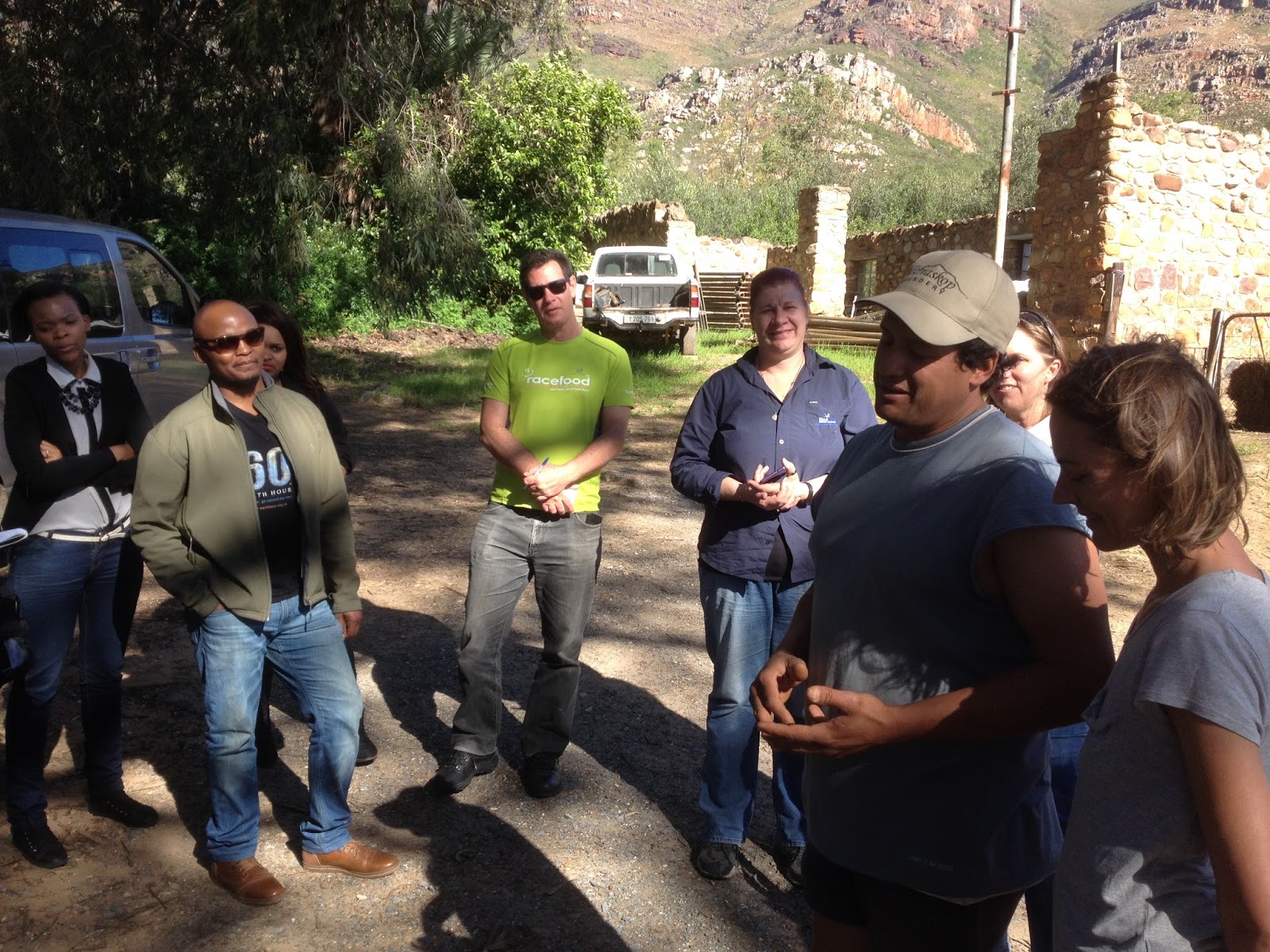
The Rothquels address us.
 The Rothquels spoke at length about their farming activities. This hard-working couple run a mixed operation, farming organically. Olives, lavender, buchu are included amongst the products which come from here. A past fire had destroyed much of the infrastructure but things had since picked up and they have bought the farm. 

Among the party that joined us on the farm was one Goldie Weideman. I cannot say that she contributed to the discussions that followed, but she stayed with us for the whole afternoon, occasionally bumping into people, drawing looks, smiles, comments and chuckles but never smiling herself. Goldie Weideman has no idea that she is a sheep. 


Goldie Weideman makes our acquaintance


We were invited to see the farm and so we set off.


Crossing streams ...
Climbing closer to the mountains and a view ...

Smelling the flowers - in this case, buchu (Agathosma betulina). Indigenous to South Africa, this shrub can be harvested for medicinal purposes.

Beehives could be seen intermittently. Remarkably, they have recovered on their own from American Foulbrood (no human intervention was required).
 
Standing underneath the leopard tree


At the furtherest point of our walk, we paused at a tree used as a scratch pad by passing leopards. After this I thought I noticed a  surreptitious look or two cast around by the party. 

Farmers respond to the leopards by keeping their flocks away from areas at the foot of the mountains, and bring livestock back to buildings and kraals at night.
  

The impressive couple would not let us leave without each of us receiving a gift of both olive- and essential oils. 


We passed neighbouring farms, one on which thoroughbred horses are bred, before pausing at a clearing where alien invasives have been weeded out, part of the Krom Antoniesrivier LandCare Project. Advantages from controlling alien vegetation are ecological and economic: less water lost, jobs created. A previous blog covers work done in this regard by the WWF Nedbank Green Trust.

Surveying the work done in removing invasive alien plants.


And then we were on the R366, travelling west, travelling parallel to Verlorenvlei, the Ramsar-proclaimed wetlands and one of the few coastal fresh water lakes in the country; travelling mostly in silence while heaven and earth became one syllable. 

At the Elandsbaai Hotel we were shown our rooms and got ready for the evening. 

Thursday, 29 September 2016

West Coast media trip: part 1


In the week when farmer association KwaNalu reported that there were thousands of oil and gas exploration applications to prospect on KwaZulu-Natal farmland (FW 23 Sept 2016), a group of journalists and team assembled by the WWF Nedbank Green Trust were looking at how the possibility of a tungsten mine spurred a group of farmers to have their area classified as a Protected Environment.


Most people enjoy a break from the routine, especially if it involves travel. When the invitation came from the WWF Nedbank Green Trust to accompany a contingent of journalists and others to the West Coast, I put my hand up and the morning of the 21st September found me in one of two silver Hyundai buses pointing north from Cape Town.

 The reader will appreciate that names like Moorreesburg, Piketburg and the Sandveld in the Western Cape have long been linked to agriculture, and during our years of compiling the agricultural publication those names have become very familiar: a group of farmers started the co-operative called Moorreesburg Koring Boere (Moorreesburg Wheat Farmers), now part of a larger agribusiness; the Sandveld is renowned for its potatoes and the conservation efforts that go with protecting its ecosystem; agricultural training providers Praktika are based in Piketberg ...

The notice of proposed mining activity in Moutonshoek, just north of Piketberg, was enough to get landowners of the area together. The alarm bells were heard in wider conservation circles and led to the involvement of Birdlife South Africa and the Wildlife andEnvironment Society of South Africa (WESSA), backed by the WWF Nedbank Green Trust.

Moutonshoek is the catchment area supplying the Krom Antonies River, which widens through wetlands, leading to the estuary at Elandsbaai on the West Coast. The wetlands are a Ramsar proclaimed site, and an Important Bird and Biodiversity Area (IBA) too, with significant populations of threatened and migratory bird species included amongst the 200 plus bird species it hosts. Also to be counted in the biodiversity of the area are the IUCN Red-listed Verlorenvlei Redfin fish (Pseudobarbus verloreni), the Endangered Diascia caitliniae, and the Critically Endangered Redlinghuys Pincushion (Leucospermum arenarium), and looking on from the mountains, the Cape Leopard. Add to this biodiversity the population of Elandsbaai, very dependent on the single aquifer under Moutonshoek and the reader will appreciate what brought farmers, conservationists and others together.

If land is as vital as the Mountonshoek-Verlorenvlei area, then there is a need to gear up from a simple conservancy to something with a bit more clout. (To see what the four Biodiversity Stewardship options are, refer to heading 5 of the "Biodiversity and ecosystems services" chapter of the Agri Handbook or click here).

After consultations, the farmers in Moutonshoek decided to go for Protected Environment status and signed a Memorandum of Understanding with Cape Nature, the provincial nature agency, to declare the intention to pursue the Biodiversity Stewardship model for the area.


At the turnoff to Moutonshoek we piled out of the buses to read the notices and to get the feel of the place. 

Monday, 19 September 2016

Announcement: 16th Annual South African Agricultural Outlook Conference

Are you ready for a thought provoking experience? The annual AMT Agri-Outlook Conference is not to be missed and remains one of the highlights on the South African agricultural calendar.

The CSIR International Convention Centre. Photo used courtesy of www.csiricc.co.za.


The 16th AMT Agri-Outlook Conference will be held on 28 September 2016 at the CSIR International Convention Centre in Pretoria. 

The theme of this year's conference is: Politics, conflicts, global warming, the world economy and the future of agriculture in South Africa. Producers, producer organizations, banks, universities, government officials, agri businesses and the media will attend. This is an excellent annual networking opportunity for all role-players involved in agriculture.

Some of the renowned speakers will be Mr. Mike Schussler, who will give an economic outlook for 2017, and Mr. Johan van den Berg who will discuss the climate outlook for 2016 and 2017. Mr. Van den Berg will give his opinion regarding rain expectations for the coming summer. Another world class speaker, Mr. Theo Venter, will present a political outlook for 2017 which will be interesting following the outcomes of the local municipal elections in August 2016. Mr. Chris Hart will share his insights in terms of the impact of policy on the economic and agricultural economic environment while Mrs. Chantell Ilbury will elaborate on the flags which indicate an increase in global conflict and what this means for Agribusiness in South Africa.

During the panel discussion the opportunity will arise for interaction between the audience and experts in their field. This year the panel of experts, which includes Prof Nick King, Dr Andries Jordaan and Mr. Christo van der Rheede, will focus on issues regarding risk mitigation within the context of climate change, water and food security as well as drought mitigation strategies and drought relieve in South Africa.

The Global and South African Outlook for the supply and demand of grains, oilseeds and livestock will be addressed by Mr. Ernst Janovsky with final perspectives on the day's deliberation that will be dealt with by Dr Herman van Schalkwyk.

The day's programme will be concluded with a gala dinner with guest artists (It Takes Four) and a lucky prize draw. This conference will provide you the opportunity to listen, experience and interact with the experts and leaders in the agricultural business environment. If you are interested in attending this conference, or want to sponsor, exhibit or advertise in the conference programme booklet, contact Mrs. Dalene Coetzer at 076 188 6533 or e-mail liaison [at] amtrends.co.za.

Find more information here.