Friday, 14 July 2017

Rustler's Valley: view from a neighbour

It was Gino’s idea that we meet a neighbouring commercial farmer or two; see what they had to say about developments at Rustler’s Valley. We had met Ray Strydom briefly the day before and so I jumped at the second name offered – Christian Findlay. 

The road leading past EarthRise Mountain Lodge to Franshoek, Christian Findlay's farm.


Findlay agreed on the phone to meet us. It was short notice and so we were grateful. Jackie dropped us off at Franshoek, and we were shown to the house. We had just sat down on the veranda when he was called away, but not before he invited us to make ourselves tea or coffee in the kitchen, something we found a remarkable show of trust.


Once he had returned, Findlay filled us in on his farming operation. He had phased out cattle and gone for sheep, but was now bringing some weaners back in again. 

Livestock belong on pastures. He is sold on Sericea Lespedeza (see the “Fodder crops” chapter and earlier post) and bales of it can be seen on his lands.


We find that his sense of fair play extends to jackal. People wanted to come hunt jackal in his mountains and he told them to "leave my jackal alone", he recounts. Like neighbour Ray Strydom, Findlay is sold on Allan Savory’s philosophy. Implementing the wagon-wheel system means no predator problems. He also has two Anatolian dogs which, if they grow up with the sheep, look after them. He speaks of finding a dead mongoose near where he keeps some poultry, and credits the Anatolians for this. 

The Anatolians double up as guard dogs, the only obvious security measure around the house. Findlay believes in treating the farm community fairly. Without their goodwill he is “a sitting duck”, he says. His polo association has for years put money towards the staff children’s education which has included daily transport for them to attend school in town, and we later find a write up about this. Horse polo has featured prominently as a sport that includes and develops farm workers in the Ficksburg district (see www.poloafrica.com and http://poloschool.co.za).
 
What does he think of developments at Rustler’s? His response is immediate. At a time when the planet is taking a beating, Jay Naidoo and his team are doing “a fantastic job”.

Christian Findlay on his veranda

He is puzzled that they did not consult neighbouring farmers about local conditions or see if there was something to learn from the people who were already farming in the area. What pointers would he have given, I ask. 

Soil is critical, and the soils on the farm will require attention sooner rather than later. Implementing Savory-linked measures will do wonders for the farm, he says. He speaks more broadly, nationally: government should apply these measures to failed farms; this would put farmers back on the (workable) land. The slangbos will need attention. He would locate vegetable operations closer to the village, to include any lesser abled people.

Evidence from other farmers in the area show that one can make it on smaller operations, and he names some of these. When what you’re paying for inputs is relatively low it is easier to keep a track on things and to measure your success. You don’t have to be “a big farmer” to make it.

Christian praises the harvest festival, the generosity of giving everyone some of the produce, including the neighbouring farmers. This scored points, he says, and will be remembered when the farm needs help. “What was the tonnage? I don’t know and that is not the point”. There are risks and challenges specific to the eastern Free State and the Naledi co-op has made its mark. 

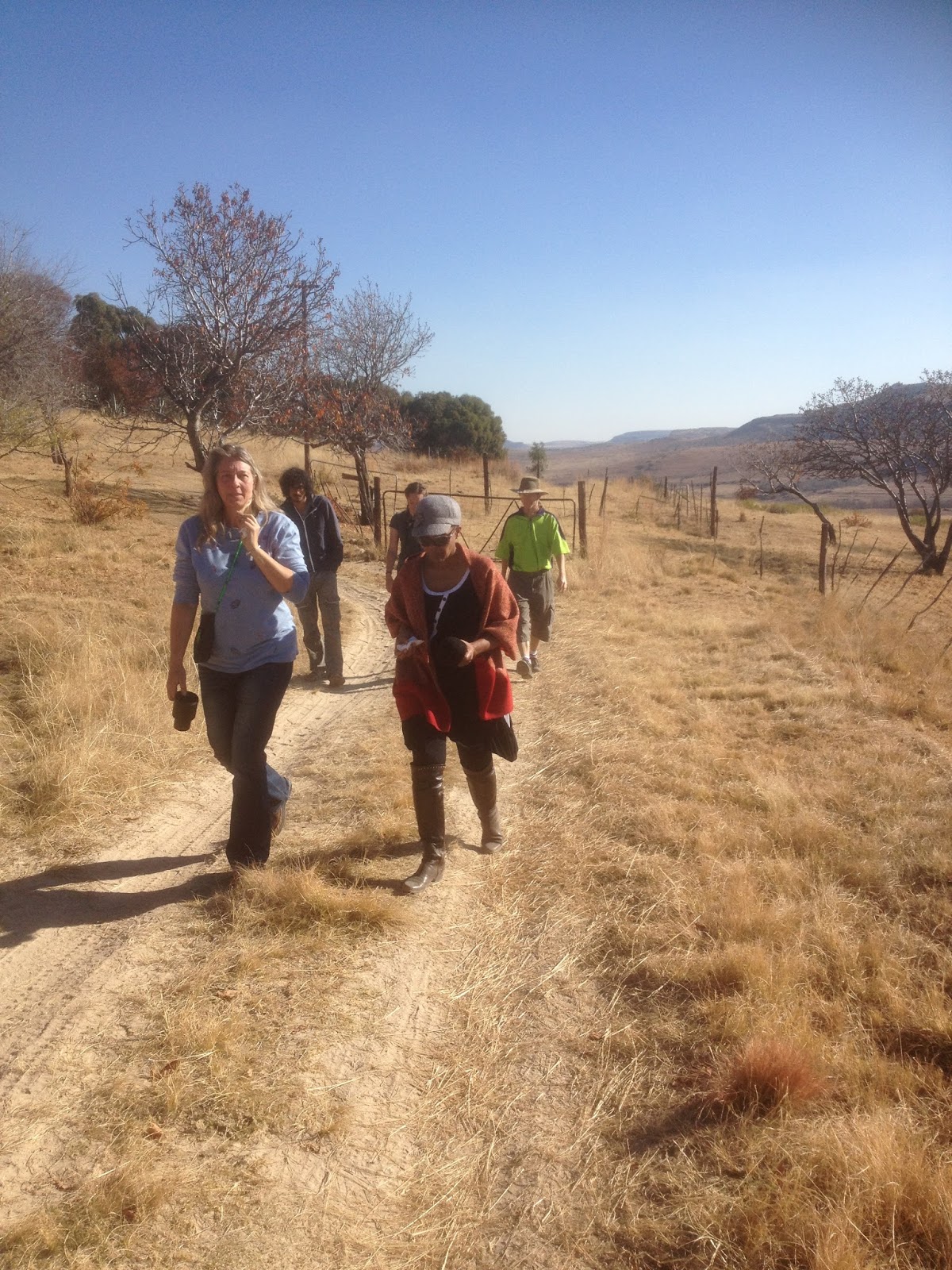
We thank him for his time. The sun has not set yet and rather than call Jackie for the offered lift we decide to use the opportunity to take in the scenery once more and walk back to EarthRise Lodge.


Rustler's Valley: nurseries and a healing centre

Generally Indigenous Knowledge Systems (IKS) has a low profile in the country, which makes the “Indigenous medicinal plants” chapter quite a task every time we update the Agri Handbook! Imagine our delight to find out that Byron and Soozi are medicinal plants experts!

Idealism without practical considerations is wearying, but these two individuals impress very quickly, and establish a sense that they know what they are talking about. They have big plans for the area, their contribution to the co-operative, but also supply the little strokes to build the case for what they are doing.

A medicinal plants centre is planned here. Why not? Many of the most useful indigenous plants, they tell us, grow within a thirty km radius of Rustler’s. Indigenous knowledge will be championed, says Byron, and a conversation built around it. Not only African but knowledge from around the world that fits this category.

In addition to a nursery for these indigenous plants, a commercial one is planned. This is intended to be a money-making enterprise. The conditions at Rustler’s are optimal for growing: at least twelve hours of sunlight every day. Much of the infrastructure has already gone up: a tunnel and shade cloth for covered growing. Racks, pipes are ready. The farm is just awaiting more funding.

Establishing a seed bank is seen as important. This will include indigenous food crops. Soozi speaks of the need to expand horizons, of not consuming only commercial plants. Indigenous crops use less water and are more hardy. Supplying the farm from this seed bank will mean the farm remains organic. They intend to expand from here, to propagate seed and become the preferred supplier to municipalities and such bodies. Established plants (as opposed to seedlings) will also be on offer.

A medicinal plant conservatory project will include the Traditional Healers Association, homeopaths and relevant parties. It will have educational and conservation purposes, tying in with what Rustler’s is all about. Travel and tourism is involved, planting days, harvesting days which employ people in the district, and tapping into the herbal market.

Plans for the nursery include fruit trees (trees can reverse climate change). Soozi points to where old cherry trees stand. She speaks of planting new trees between the older ones, giving the older ones a parent function. As we walk, van der Linde points to the swales on the farm, ridges constructed to retain water after rain. She speaks of other potentials on the farm: rainwater harvesting, the use of grey water for use in toilets. There are plans to have a borehole (indeed, Gino had excused himself from events this day to meet to borehole-related visitor).


Approaching the Healing Centre
Soozi and Byron have fifteen different courses and retreats planned. We are now standing at what will be the Healing Centre. Included among the medicinal plants and IKS courses are ones that are not horticultural at all, ones like yoga and meditating. They fit under the umbrella of the place though, and the objective of wellness and health. Ablution blocks are being constructed using the bricks made on the farm.


Building rondavels at the Healing Centre
... and ablution blocks


Soozi picks up on the permaculture credentials, potentials, of the place. Permaculture founder, Bill Morrison, gave his first training in this country here at Rustler’s Valley. Under the old owner, gardening was done for individual homesteads though; it was not a common (what today’s is).

She points to the rows of bluegums and speaks of the protection they provide for crops from the wind. Fire and water are the two major threats on the farm. To safeguard the farm, use is made of winter (to clear waterways) and summer (to ensure measures to deal with fire).

She points to the aloes, planted to keep soil in place. They have a flat root system and are ideal for this function. Aloes grow on the steep side of mountains; humans can copy the principle in using them. In addition to being a permaculturist and medicinal plant expert, Soozi champions biomimicry too.

Soozie is also qualified and registered as a carbon-footprints analyst, and ponders the implications of vehicles arriving/leaving Rustler’s, the mechanisation, livestock, the lifestyle. It is important to plant trees to offset carbon. Carbon is a waste product and I am not surprised to find that waste management is among her skills.

We are headed back for to the reception and our vehicles.


Wednesday, 12 July 2017

Rustler's Valley: Naledi Village Farmers' Co-operative

 
Jackie Zondo is clear on one point: “Everything you see is an initiative of the community”.

The point is discussed in several places – how a community must be included in whatever has to do with them. In our Boreholes & windmills chapter, for example, a role player discussing water supply systems for communities calls this the “most important … and most neglected part of the installation process”. Participation is meant to be the bedrock of democracy (see discussion in a later blog in this series). It is certainly central to any understanding of a co-operative, and EarthRise’s venture with the Naledi Village Farmers’ Co-op has shown a keen appreciation of this:  the community has been involved in every step.

Morning breaks over the conference centre where a baker from Ficksburg is presenting training in baking technology


Stones are used to keep roofs down. In the event of having to relocate, the roofs can be used again and will not have been pierced by nails. Transferring ownership of some ground to the community itself has ensured security of tenure.
Jackie speaks much of community buy-in. She refers to the first ever Harvest Festival which had been held the previous weekend, a vindication of all the efforts so far, and of the intention to drive their own destiny.


 We arrive at the Naledi Village Farmer’s Co-op office. In the distance, cattle belonging to the co-operative are grazing the left overs from the harvested sugar beans [also called “dry beans”]. At the Harvest Festival, beans were handed out to all co-operative members as well as attendees, including neighbouring commercial farmers.


 The co-op grows vegetables including beetroot, spinach, tomatoes and butternut. The vegetables were the crops that made the initial slash (covered in Jay Naidoo’s book Change) and gave the community its first glimpse of what could lie ahead. Inside the office we would later see evidence of some adding-value activities like jam.


The skeletons of buildings razed by the fire years ago are in evidence. We walk through them and come to a place where experimentation has been done with different construction methods. We will be meeting the brick making enterprise later – all part of creating a local economy.


Sifting sand for brick making. The other two ingredients, river sand and cement, are sourced from outside the farm.

Bricks made on the farm. They have an interlocking design, lessening the need for cement.
Rustler’s is seen as a “safe space where ideas are tested”, a “learning space”. Behind the lodge, we are told, there is a home built from cut aways of wood. The ideal is to have a local community team, competent to attend to the building of new structures and taking care of the old. There is other farm infrastructure like roads which will require attention. The possibility of creating a local maintenance company is posited.


In the courtyard outside the co-op's offices we are introduced to Jim, who builds and repairs furniture. He was loading a table on a bakkie for delivery. Also to be seen in the courtyard were two diesel tanks. The price of fuel was to drop the following week, and there were plans to top-up the tanks then.


We walked around to the front where we met Byron Maclean and Soozie van der Linde. 


Tuesday, 11 July 2017

Rustler's Valley: the children


After breakfast, we set off on our tour to see what was happening at Rustler’s Valley, what the Naledi Village Farmers’ Co-operative were up to. 

The crèche
 It began with the crèche and, next door to it, the school. I smiled at the appropriateness: children are the foundation of any enterprise or society, and the energy invested at this level ensures the longevity (and ultimate success) of whatever we set our hands to, be it family, village or nation.

We arrived at the buildings. To the right, where we were going to start, was the crèche. A protective fence rings the premises (government regulation). Jackie and Kami Naidoo, who had joined us for the day, took us through the rooms and introduced us to Mpho and the fourteen children aged between two and six years old. 

After treating us to a song, the little ones stood in silence, looking at the adults in the room and waiting for whatever was to happen next. Kami Naidoo surprised me by asking whether I would tell them a story. 

I did the only thing which came to mind: a simple role play illustrating the importance of learning language. It is what they are doing: colourful pictures, letters of the alphabet and words adorn all the walls of the centre. Learning the basics of literacy here helps the children (to say nothing of the teacher) for the next phase, namely school. (I would use the same role play a few minutes later at the school).

The Naledi Village Farmers' Co-op is busy tying up loose-ends to get the crèche registered. This holds advantages like accessing social grants.

We exit, go around and stand at the school gate. We must wait to be allowed onto the premises -- school policy controlling traffic to the classrooms. Another silent nod of approval from us.

Mme Justine (Justine Rapulome) is the school, in the sense that she is the sole teacher (which also means the sole administrator, principal, psychologist, social worker and other roles inherent in teaching). Repairing the school was one of the first tasks on the agenda when EarthRise Trust took over Rustler's Valley (covered in the YouTube clip, EarthRise Trust - an overview).

 When mme Justine hears "agriculture" in my job title she points to soil outside the buildings which she would like to rejuvenate for a school garden. I say that I am not a soil scientist, but would recommend the more organic steps to enriching this soil. Earthworms and vermicompost and Compost and organic fertiliser would be two relevant chapters from the Agri Handbook. Indeed, there is enormous potential with earthworms, and companies like Wizzard Worms do sterling work with communities.

I repeat the short role play in which two children must communicate how they are feeling without using words is a simple way to show the importance of language. We thank the school and head back to the bakkie, keen to view what the parents and other adults on the farm are doing.


Friday, 7 July 2017

Rustler's Valley: return to the lodge


As we descended, we caught intermittent glimpses of a figure in the distance, probably making his way towards us. We smiled to see the person whose team had given us such a welcome on the previous evening - Jappie.  After greetings all around, we set off, treading the soft, dusty road back to the Lodge.


Before long a Toyota Hilux came past: neighbour Ray Strydom. After initial words with Jappie he looked at me and, taking the cue, I introduced myself and the team. He invited me to speak in English.


Included in his first comments was a reference to Sericea Lespedeza (see the “Fodder crops” chapter), and it was no surprise to establish that he knew the late John Fair and is familiar with Alan Savory’s Holistic Management [watch Savory’s TED talk for an excellent summary or refer to the Savory Institute website for more]. Sericea Lespedeza was championed by John Fair, who as a matter of principle termed it “prosperity lucerne” rather than its colloquial term, “poor man’s lucerne”. In some quarters the crop is regarded with a measure of apprehension as it can overrun other vegetation. For Strydom this is no problem. “Just bail it!” he says. Indeed, this is what has happened on lands adjacent to Rustler’s Valley.

I mention that we have come to see how the Rustler’s project is working, adding that private sector initiatives stand a better chance of success than government ones. He does not really respond and I realise that security on farms is something closer to his heart. "Farming is not for sissies", he says grimly, and after more words with Jappie, whom he refers to as his friend, he drives off.

As we resume our walk back to the lodge, Jappie begins speaking about life on the farm. It would only be later that I realised that although he is in charge of EarthRise Mountain Lodge, that he lives in the neighbouring Franschoek Village, not in Naledi Village which is located on Rustler’s Valley farm. The difference between the two villages and its implications would only become clearer to me later on in our stay.

Working on the mines showed him the potential of education, and of educated, trained women in particular, who could do many of the same jobs as men. The unrealised potential of staff children on farms and disappointment in farmer support for them is something that he feels keenly.

No one is stupid! Not everyone can be the driver or do some particular job. He speaks of the importance of finding a good way of using the people.

He picks up on the issue of security. Having buy-in from staff is better than having the assistance of police from town. When you move villages, where the staff have been living, or change your mind about allowing them to keep a few cattle on your land, you break trust. I later find out that both incidents referred to have indeed happened in the near vicinity.


But lack of education is the one thing stopping organic development on farms. Boys get more opportunities than girls after primary school, since there are fewer social inhibitors for them in the township to where they must go to pursue a high school education. He speaks of his journey to discovering the presence of three boarding schools for girls in Qwa-Qwa and the solution this offered to young girls on farms with limited prospects of furthering their education. On the farm women can do many of the jobs done by men, and he lists testing soil and work in the dairy as examples.

“It is education that enables you to stand on your own. Education will take what is here and make it grow”.

We leave the dusty road and take the steps up to EarthRise Mountain Lodge – and breakfast.

Rustler's Valley: the hike

The outlines of mountains were hinted at in the growing light of a new morning, and then there they stood, playful and confident, and with them the familiar scenery of the eastern Free State. We had been aware of the gathering mountains as we journeyed towards Rustler’s Valley farm the previous evening but had arrived at the farm in the darkness.

Jappie Lephatsi and his team in the reception of EarthRise Mountain Lodge reception had welcomed us, offered us supper while we confirmed the agenda for the following day. Now on the Wednesday [12 June] we stood contemplating the scenery before us. We were going to do a hike before breakfast, and then be given a tour of the farm and the various activities that make up Naledi Village co-operative.


Hospitality and tourism is a big draw card for this area of the country, and several farms offer accommodation and leisure/tourist activities. An obvious value-add, we thought, as we welcomed the prospect of this outing and the country air.


Not far from here lies the Golden Gate Highlands National Park, a major tourist attraction in this province and worth a drive through by anyone interested in the country. After the relatively flat grasslands and occasional hill in the rest of the province, the geographical features of mountains and sandstone in the eastern and north-eastern Free State are a delight.


The silence and presence found at the end of this trail, enclosed by rocks, verdant vegetation and a stream of water dropping  down from the sky, calls you to spend more time here. Today, however, there were things to do and see, and after spending as much time here as we could possibly afford, we turned back.

Thursday, 8 June 2017

Rustlers Valley and agriculture (Part II): What problem do you most want to solve?


“What problem do we most want to solve?” The question is posed by Gino.

Gino has a history of organising and strategy, in trade unions and human rights organisations. His path has led him here, to being one of the founding members of EarthRise Trust, a not-for-profit initiative based on the Earth Charter. The setting of Rustler's Valley farm and its village, Naledi, is ideal to form and build a model of community organisation. This is all about more than Rustler's: the aim is to get a working, functioning model which can also be used elsewhere. The journeys of Jay and Kumi Naidoo, fellow trustees of Earthrise, have also brought them here. Jay’s book, Change: Organising Tomorrow Today, describes his journey, which includes visits to other countries like Kenya and Bangladesh, to learn from what is happening on the ground there, lessons which culminated in the “Naledi star”. (There are brief notes on Gino Govender, Jay and Kumi Naidoo under the “Trustees & partners” option at http://earthrisetrust.org.za).


Building (photo used courtesy of Earthrise Trust)
 Already the foundations of a local economy have been laid on the farm. It includes a brick making enterprise and a bakery. Medicinal plants are grown and a nursery established which supplies seedlings for the farm and village. Old infrastructure has been resuscitated and expanded, and so Rustler's hosts a yoga studio and old sweat lodge, a conference centre with facilities for weddings, workshops and such gatherings. The EarthRise Mountain Lodge offers seven different options for accommodation, and there are mountain bike and hiking routes, fishing and, on a neighbouring farm, horse riding.


Mountain biking (photo used courtesy of Earthrise Trust)
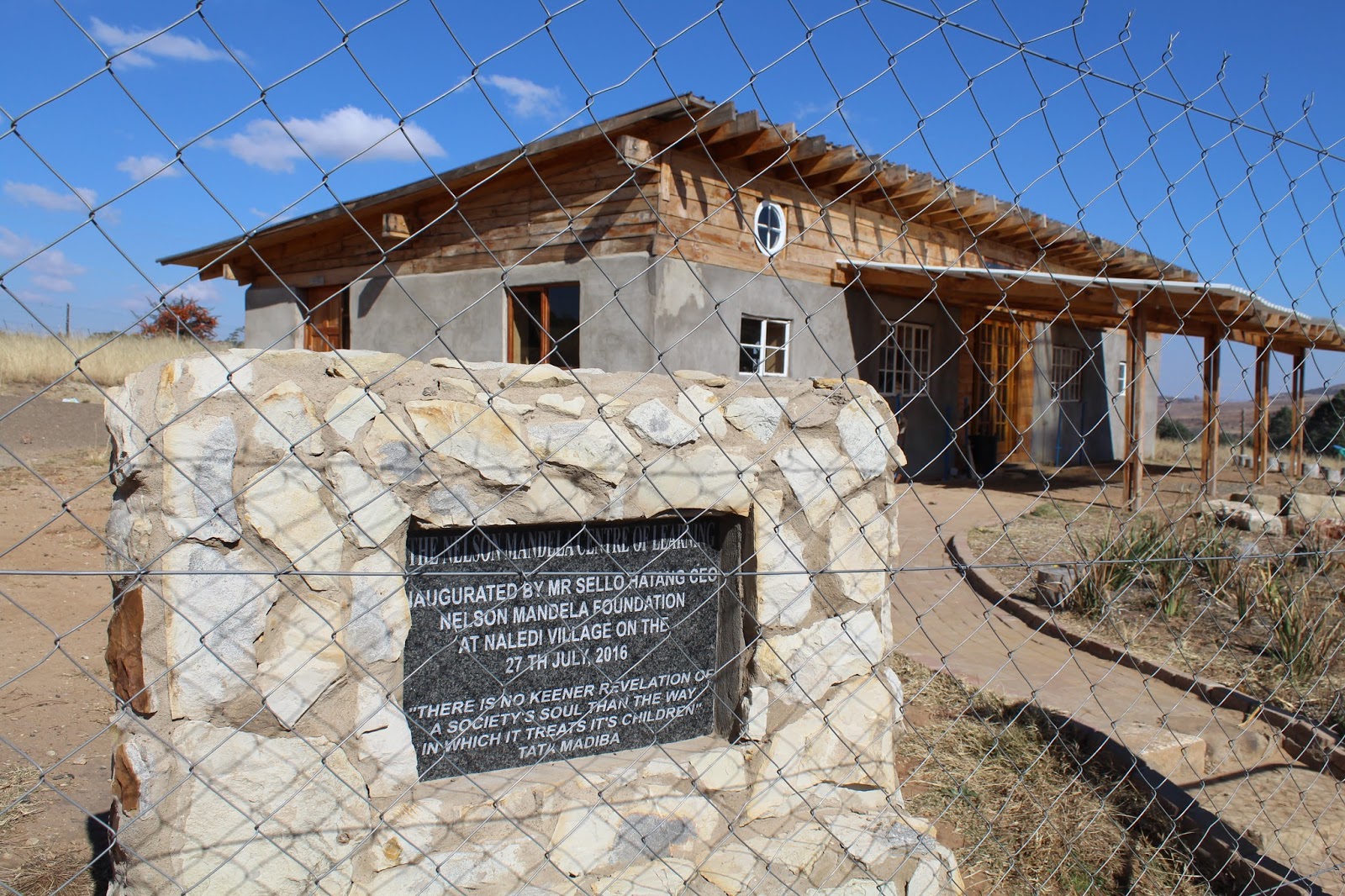
It has been a journey. Trying to get the papers for the land, registering the co-operative, getting buy-in from various quarters ... The Industrial Development Corporation (IDC), Old Mutual Foundation, Nelson Mandela Foundation have all played a part so far. Contact has also been made with organised agriculture, and bridges formed with neighbouring farm owners. 

In addition to basic food security, space (20ha) is also set out for commercial enterprises. Rustler's Valley farm previously grew and exported asparagus before being turned into a permaculture food garden to supply lodge and restaurant with food. The land thus has the selling point of not having seen chemical fertilisers or pesticides for over two decades. 

“What problem do we most want to solve?” 

“A society where no one goes hungry” is Gino's answer. If you look carefully, the sentence says at all. If you want footnotes or qualifiers, the EarthRise website sets out its philosophy and objectives and broader goals. A complementing perspective is offered by Lucie PagĂ©, another person linked to the project: “We put the human being first, and everything radiates around that”. She is speaking on a YouTube clip, EarthRise Trust – an overview.   

The week after our meeting with Gino, we received an invitation from Rustlers Valley and the Naledi Village Farmer’s Coop:

  
We found the invitation on Twitter too, under #HarvestFestival. The event is planned for Saturday 17th June. We will not make it to the festival itself but will be spending three days in the week following it at Rustler's to see for ourselves the progress made.  Watch this space!