Tuesday, 22 January 2019

Digitally transforming agriculture across distances


  • Cloud based solutions enable 50% savings
  • Sensors can transmit vital information over 50 kilometres
  • Digital data speeds up compliance reports


The implementation of the cloud, the Industrial Internet of Things (IIoT) and Industry 4.0 can offer benefits to the agriculture industry by enabling farmers to optimise their operations through digital transformation, thus feeding the world more efficiently and sustainably.

Global demand for food is expected to double by 2050 and farms will need to scale up production to accommodate this demand. Farmers must also increase their sustainability efforts – around two-thirds of South Africa’s water is used for agricultural purposes, specifically irrigation and, as South Africa is ranked as the 30th driest country in the world and a high water-stressed country, efficient and effective use of this finite resource is critical.

“Schneider Electric foresees three trends that will digitally transform agriculture,” explains Marc Ramsay, ‎Vice President Anglophone Africa Industry Business Unit at Schneider Electric.  “These are cloud based deployment, improved visibility and control of equipment and the need to be sustainable and compliant.”

Implement lightweight cloud deployments

One traditional barrier to adoption for digital transformation in agriculture is the mismatched capital investment and existing infrastructure, as the average farm was not built to handle large, on-premises software installations. Cloud-based solutions are crucial to expanding digital capabilities to farms – a cloud-based solution allows farmers to experience the benefits of digital transformation without extensive capital investment or large IT overhead. Selecting a scalable, hardware-agnostic cloud solution allows farmers to build on top of existing hardware easily, without worrying about interoperability issues.


Focus on improved visibility and control

Farmers operate in a very time-sensitive environment, where they need to be responsive to quickly shifting weather, crop and market conditions. Furthermore, fields and equipment are kilometres apart, which means that conducting accurate, on-site assessments requires extensive travel time. Farmers can realise significant benefit from digital transformation solutions that allow them to see how their equipment is performing, whenever and wherever they are. Advanced cloud and mobility capabilities mean farmers can view the status of critical equipment such as irrigation pivots, AND they can control it – directly from their smartphones, tablets or other mobile devices – so pivots can be turned on or off, water delivery adjusted, or pumps started or stopped.


Enhance sustainability, efficiency and regulatory compliance

The enhanced visibility and control provided by digital transformation allows farmers to use their resources more efficiently, reducing costs and increasing sustainability. For instance, a cloud-based IoT system allows users to adjust their irrigation pivots based on rain levels, allowing farmers to reduce water and energy costs. One farmer has reported a 50% reduction in energy costs and up to 50% reduction in water flowing through his meters – attributed entirely to the increased visibility the cloud IoT solution has provided.

Another major cost that farmers face is their regulatory burden, with increasing environmental regulations requiring extensive documentation to show compliance. Digitised solutions provide extensive archived data stores, enabling fast retrieval of key information for improved regulatory compliance.


New technologies breach distance

New low-power wide-area network (LPWAN) wireless technologies have broken through the 100-metre ceiling and now reach up to a 50-kilometre distance. This allows new LPWAN enabled sensors to detect and respond to environmental inputs (such as position, pressure, or other event-driven state changes) and then send a signal to a remote transmission station and then on to the cloud.

 “The sensors connect to the cloud using antennas similar to mobile phone antennas that access traditional wireless networks via cell phone towers. Once transmitted to the cloud, the sensor data is interpreted by applications that reside on our servers and then transmitted to a laptop, or to an application on a tablet or cell phone,” continues Ramsay.

 “Schneider Electric demonstrated these sensor-based applications at the IoT Solutions World Congress in Barcelona Spain in late 2017. One of the test beds demonstrated an irrigation system that provides water to crops. Until now, irrigation ramps were not able to support any type of sensor because the data created was not retrievable. The new technology enables global sharing of information as it pertains to water pressure so that efficiency and energy can both be optimised.

The second test bed illustrated how a distant valve can be monitored so that accidental release of wastewater and harmful chemicals into a river or lake can be avoided. If the valve is open, information is sent to an operator via an alarm on a mobile device.

“Schneider Electric has collaborated with Microsoft to provide the Azure cloud infrastructure, which enables irrigation monitoring and control from mobile devices, improving operational agility, efficiency and sustainability. The cloud management technology ensures that information can be shared quickly and conveniently with key stakeholders. We look forward to assisting the South African agricultural industry into a digitised future,” concludes Ramsay.

Media release by Schneider Electric

AGCO launches innovative Farm in a Box initiative for Africa Taking farm mechanization deep into rural communities

Capacity-building and agricultural mechanization are a priority to facilitate food security and unlock the potential of small-scale farming in Africa

BERLIN, Germany, January 21, 2019/ -- AGCO, Your Agriculture Company (NYSE:AGCO) (http://www.AGCOcorp.com), a worldwide manufacturer and distributor of agricultural equipment, unveiled its pioneering Farm in a Box (FIAB) initiative for Africa at Germany’s International Green Week 18-27 January 2019.

“With this brand-new new concept, we aim to take farm mechanization plus all its necessary support facilities deep into previously underserviced rural communities in Africa,” said Martin Richenhagen, President, Chairman and CEO of AGCO at the launch event.

FIAB offers a package of essential farm equipment including a tractor and implements together with the crucial support mechanisms such as parts, workshop tools, training and expertise to ensure sustainable and productive machinery operations. Some of the equipment is packed inside a box – a modified shipping container – which is then used as an office or workshop.

In sub-Saharan Africa, humans provide 65% of the power required for land preparation. Capacity-building and agricultural mechanization are a priority to facilitate food security and unlock the potential of small-scale farming in Africa. AGCO’s FIAB is an innovative solution for small-scale farmers to gain access to the machinery they need to transform their operations and achieve profitable businesses.

Designed to provide a holistic solution, FIAB is localized farm support center which delivers mechanization services to rural communities. Research shows that demand for machinery is high in these remote areas but barriers such as affordability, availability, maintenance/repair services and inadequate farmer skills and training are hindering the uptake of mechanization. 

FIAB offers a 45-80hp tractor and implements - such as a ripper, disc harrow, trailer and planter - to carry out land preparation, planting and crop transport, plus parts and workshop tools for their service and maintenance. The objective is to offer ‘for-hire’ mechanization services to small-holder farmers, enabling them to reap the benefits of agricultural equipment without having to invest in capital assets. The package includes training programs and support from a dedicated AGCO Operations Support Center which provides technical advice and guidance. Importantly, FIAB takes maximum advantage of the latest telemetry and mobile technology to enable remote monitoring of the equipment and the use of mobile apps. This high level of monitoring, support and guidance from AGCO really sets the concept apart. 

FIAB is very much an entrepreneurial platform and operates on a franchise model, with franchisees appointed and trained by AGCO and the in-country Distribution partners. Typical franchise holders would be those with relatively well-established businesses successfully serving the agricultural community within their sphere. This franchise model helps build the capacity of small-scale enterprises and provides business opportunities for entrepreneurs, contractors and the many specialty agricultural supply stores – known as agro-dealers – present throughout Africa’s rural areas.

“The thinking behind FIAB is definitely outside of the box but the benefits literally come inside a box!” remarked Mr Richenhagen at the launch event. “It’s a win-win situation for all participants.”

Acting as a localized hub of know-how and practical help, the franchise partner offers hire of equipment and drivers to local farmers and small-holders, enabling them to boost their crop production processes and output. Furthermore, franchisees expand their businesses and provide potential new employment opportunities in the locality. Local communities benefit from improved economies as a result of the enrichment of the agricultural value chain. For AGCO, it leads to increases in sales of products and services and further develops the company’s footprint in Africa.

“With AGCO’s wide-ranging experience serving African farmers, the company is uniquely positioned to develop innovative solutions to meet the challenge of sustainable and productive farming on the continent,” said Mr Richenhagen “There is an urgent need to empower the millions of smallholder farmers in Africa to ensure food security. Tailored, inclusive and integrated approaches to agricultural mechanization can increase the welfare of farm households and create opportunities for economic growth in rural areas.Our Farm in a Box is yet another initiative fulfilling AGCO’s commitment to ‘Run Africa from Africa’.”

Distributed by APO Group on behalf of AGCO Corporation.

Wednesday, 19 December 2018

Overberg media trip: Flower Valley Farm (part 8)

The rationale behind the Flower Valley Conservation Trust (FVCT) is straight-forward: “… if we pick all the fynbos this year, there will be no fynbos to pick in the future” (Van Deventer et al, 2015).


The media party was greeted by Roger Bailey (Operations Manager) and Kirsten Watson (Conservation Manager). Heather D’Alton (Communications Manager) had accompanied us from the packhouse (see previous blog). After a short restroom break, we set out on a tour of the farm to see the harvesting operation. 


Whether the job involves picking/marketing fynbos, removing invasive alien plants or conservation and ecotourism, many livelihoods happen because of fynbos, and so it is in the interests of everyone in the Overberg (and beyond) that its Cape Floral Kingdom is properly managed.


The benefits of fynbos go beyond the economic value referred to above. When they aren’t pollinating fruit trees, honeybees feed from the fynbos flowers. In a particularly water-stressed province, fynbos allows more water to make its way to rivers and dams because it does not consume as much water as invasives do. (Not only do invasive alien plants guzzle precious water, but they also prevent fynbos from growing).


Fynbos is protected by law. It is illegal to pick it without the appropriate licence from a conservation authority like CapeNature, and if you clear fynbos veld to make way for another crop you face jail time and a fine.


To protect both fynbos and the jobs that it makes possible, the Sustainable Harvesting Programme (SHP) was initiated in 2003, the result of ten years’ work by FVCT, Cape Nature, experts and the fynbos industry.

Recognising that farming enterprises need to make money from their operations, the SHP offers landowners certain benefits in exchange for joining the Programme:
  • Greater access to markets which are increasingly environmentally conscious
  • Help in meeting all the criteria set out in environmental and labour/social legislation
  • Extension support
  • Access to tools to monitor your harvesting

The SHP Toolkit offers supports with securing the necessary floral license, field assessments and training opportunities. In short, it allows for both responsible harvesting and fynbos veld monitoring.


This has been greatly assisted by the development of an app, the i-Fynbos. The app includes the Flower Valley Field Guide: a photograph of the flower and a description assists the harvester to know which flowers can be picked and which should be left alone (some plants are unique to the area – if they are wiped out here, they are wiped out for good!)


Most of the land in the fynbos biome is owned by farmers whose margins are tighter than ever before. If they don't turn a profit they go out of business, a consideration among the many other concerns, be these political, social or environmental. It is noteworthy that the work being supported by the WWF Nedbank Green Trust - like the Flower Valley Conservation Trust - includes practical assistance for landowners.


Back at the Flower Valley office there are more conversations over our lunch packs. The realisation has come that fynbos, up to now covered in the "Cut flowers" chapter, requires a chapter of its own in the Agri Handbook, and so I have several questions for both Watson and Bailey.

Soon we are on the road again, making our way to Cape Town. The contribution of the Cape Floral Kingdom to this region is immense, and as we view it through the bus windows I give a quiet thank-you to the people who are making the effort to ensure that it is looked after.

Friday, 14 December 2018

Overberg media trip: fynbos packhouse (part 7)


The world is divided into six floral kingdoms, according to the plant types occurring in each given region. The smallest and richest of these is the Cape Floral Kingdom, found only in the southern tip of Africa – in the Western Cape through to Makhanda (Grahamstown) in the Eastern Cape – and nowhere else in the world.


This 200 kilometre-wide region has a Mediterranean climate – cold, wet winters and summers that are hot and dry.

The main vegetation type is fynbos. Most of the plants are shrubs and bush, with fine, small leaves from which the name fynbos is derived (the Dutch fijnbosch is translated as ‘fine bush’). Renosterveld, the subject of the previous blogs in this series, is a cousin to fynbos.


Fynbos may have adapted to both the weather and the nutrient-poor soils, but of late the threats have come from a different quarter:

  • Urban expansion
  • Agricultural expansion
  • Too frequent fires or fires “out of season”
  • Over-harvesting of fynbos for markets
  • Invasive plants


These challenges have translated to a disproportionate threat to fynbos flora: three-quarters of South Africa's threatened plants are found here; over 1 805 species threatened with extinction and 3 296 of conservation concern.


Nomonde Mxhalisa from the Green Trust (right) checking on arrangements


One can understand the involvement of the WWF Nedbank Green Trust, along with conservation groups and initiatives like the Flower Valley ConservationTrust and the Agulhas Biodiversity Initiative.


Geographically it made sense to stop at the nearby fynbos packhouse before proceeding to where the fynbos is harvested. 


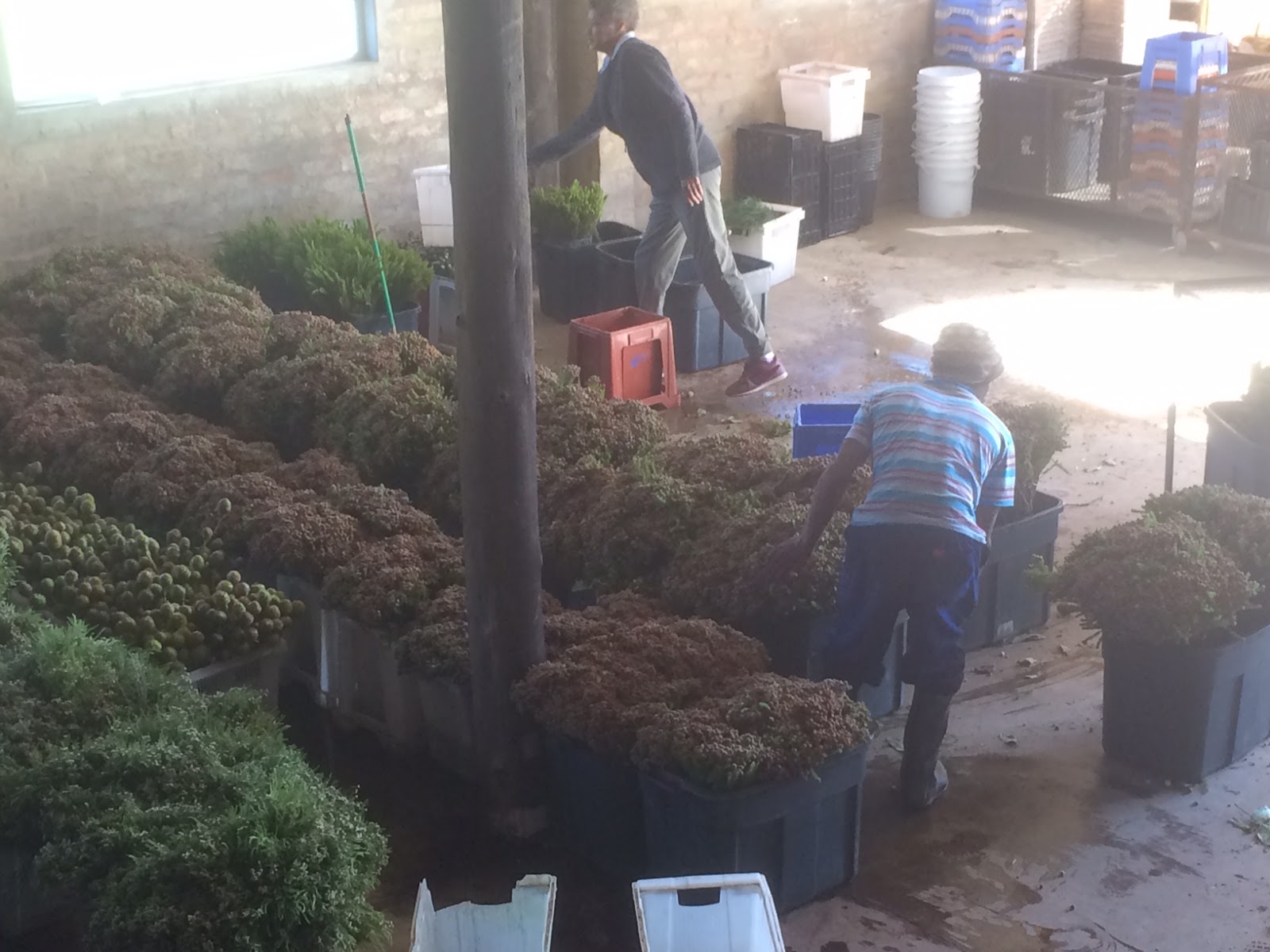
Here in Napier the fynbos is sorted and prepared, before packers make bouquets from them. 


These are sold in supermarkets, florist shops and by informal traders. Bouquets are exported, mainly to Europe. Fresh fynbos goes mostly to the Netherlands to be sold at flower auctions. 


Dried, bleached or coloured fynbos is exported, Germany being one of the dominant destinations.


Onkemetse Nteta (WWF-SA) and the man who drove us safely, Mohammed Rassid


After an hour's stop we returned to the bus. We would be travelling to see where the fynbos value chain begins ...


Wednesday, 12 December 2018

Overberg media trip: A research centre and a place to stay (part 6)

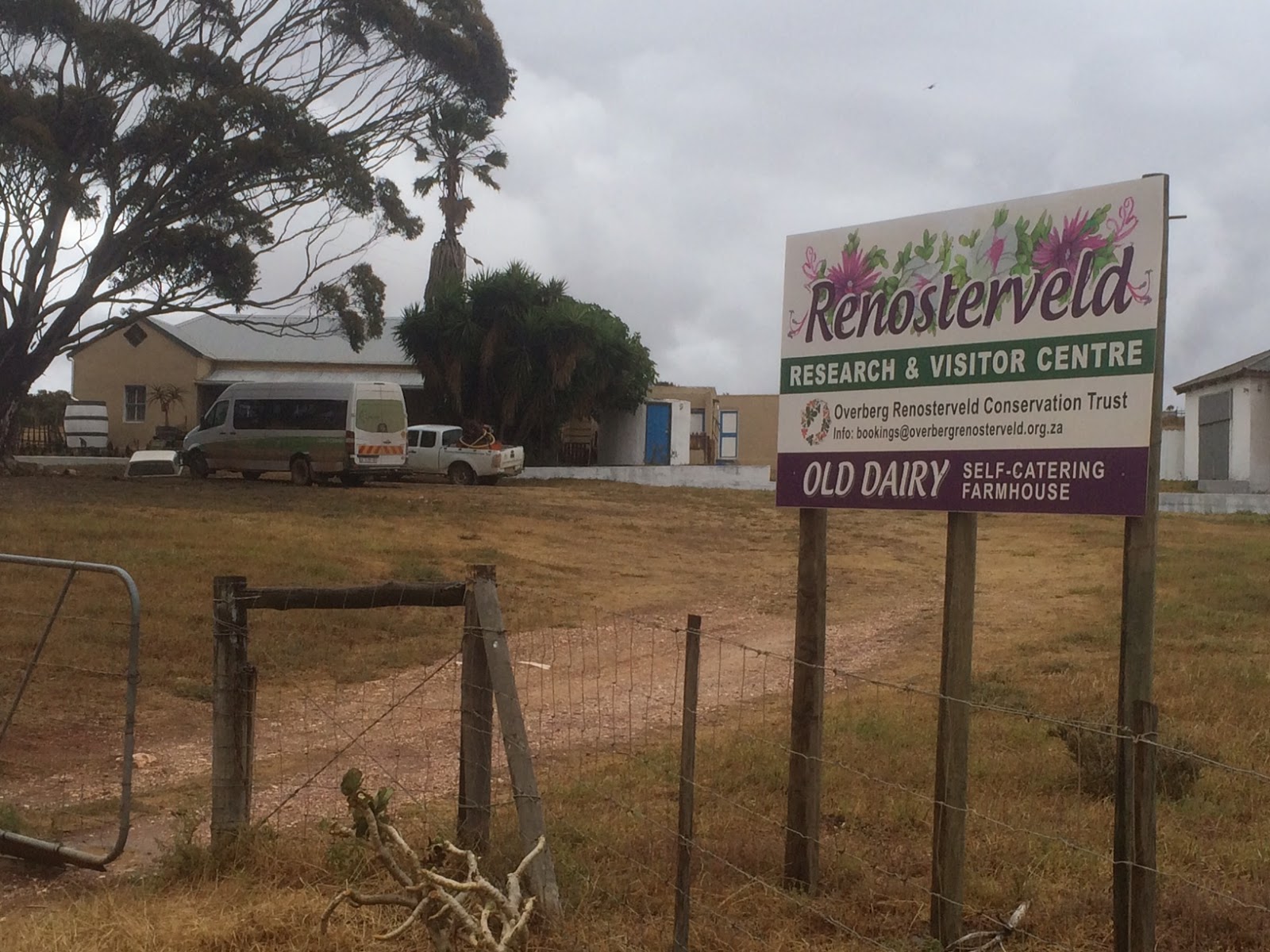
On our second day, the Haarwegskloof Renosterveld Reserve and its Research and Visitor Centre were on the agenda. It was an overcast day, and we travelled with the promise of rain in the air.


The WWF-SA had purchased 500 ha of Eastern Rûens Shale Renosterveld in 2013, through an initiative driven by the Overberg Renosterveld Conservation Trust (ORCT), before handing it to them to manage. The original farmhouse was converted into the Research and Visitor Centre, and the old dairy became a beautiful self-catering guesthouse.


 We arrived moments before the rain, and would spend between two to three hours at the centre.

Lynch explains how the purchase of the reserve helped enormously with the linking up of watercourses and consolidating Renosterveld in the Eastern Rûens Cluster.


Grassbird. Photo used courtesy of Dr Curtis-Scott
"Why stay at our Haarwegskloof Renosterveld Reserve?" reads the Overberg Remosterveld Conservation Trust (ORCT) website, with a background photo of tidy, simple but comfortable lodgings. In a smaller font "We offer a peaceful, relaxing stay in the renosterveld". Bird watchers would be interested to hear that there are over 80 bird species here.

Agulhas Long-billed Lark

The reserve is home to a wealth of plant life, with over 500 species. Some of the rare and endemic Renosterveld plant ones include:

  • Moraea elegans – a bulb in the iris family;
  • Polhillia curtisiae – a member of the legume family, named after Dr Curtis-Scott who discovered it here at the Reserve;
  • Hesperantha kiaratayloriae – a bright pink bulb.

Moraea elegans. Photo used courtesy of Dr Curtis-Scott

Jannie Groenewald, Reserve and Centre Manager, has a plant species, Haworthia groenewaldii, named after him. Deservedly so: his MSc in Conservation Ecology and conservation feats can be read about on the ORCT website.


Among the mammals, amphibians, reptiles and invertebrates which occur on the reserve are three of the Little Five (the Elephant shrew, the Ant lion and the Rhinoceros beetle).


Cape Rock Elephant Shrew. Photo used courtesy of Dr Curtis-Scott
Capturing footage of the reserve


Some of the group pose for a photo. The ORCT's Jannie Groenewald, Odette Curtis-Scott and Keir Lynch stand on the left.


Nomonde Mxhalisa (WWF-SA Nedbank Green Trust) enjoys animated conversation with Lynch and Onkemetse Nteta (WWF-SA).


On our return trip we stopped to view some of the Renosterveld pointed out to us on the map, before hitting the road.

"Come for the day, or spend a night or three in our Renosterveld Reserve. Take leisurely walks, or just relax in this historic area", says the ORCT website. Read about accommodation on the reserve by taking the "Come stay" option or click here.

Tuesday, 11 December 2018

New beeginnings: innovative hive design set to revitalise local beekeeping

Local beekeeping is currently faced with a range of challenges, including adverse weather conditions and the rapid decline in bee numbers worldwide – which is a global concern seeing as bees pollinate crops that are produced for human consumption. The cheap price of low-quality imported "honey" is also a threat to South African honey farmers.

Wooden vs concrete beehives. Photo used courtesy of Beegin.


However, a new type of beehive has the potential to revitalise honey production in this country. The concept sees traditional wooden hive structures replaced with an innovative concrete frame. Although a concrete hive is not in itself a new idea, the new Beegin hive provides several design adjustments that have helped a test group of beekeepers to increase their productivity.

The progressive, aptly named Beegin was created by Ivan Brown and was born out of this intrepid industrial design student’s goal to expand local beekeeping and contribute to both job creation and food security in this country. Brown is currently studying for a master’s degree at the University of Johannesburg. His work on Beegin, which started as a research project, has been featured at several international design conferences. He has also co-authored several research papers.

Brown came up with the design when he entered the PPC Imaginarium Awards, the country’s most supportive arts and design competition for emerging creatives that seeks to reward innovation in concrete. Brown was named the runner-up in the industrial design category of the awards in 2015 and PPC then supplemented Brown’s prize money with a seed grant to assist him with prototyping his initial concept. PPC has since assisted Brown with further funding to aid the nationwide rollout of the project after a successful testing phase.
Ivan Brown. Photo used courtesy of Beegin.


The testing process took two years. In that time, all ten of the participants (five beekeepers and five urban farmers) were kept appraised of Brown’s new beekeeping technology.

“The testing process was fantastic!” he adds. “We uncovered a range of issues with the original design and the production process. We refined the entire system.”

For the farmers involved, these tests served as a learning process, teaching them to introduce and keep bees on their farms. Since then, honey production has increased considerably.
Having learned the requisite skills, farmers and beekeepers are now able to serve as access points in the community. Marginalised farming communities may thus manage to take part in processes surrounding the keeping and introduction of beehives.

In addition, the insulation properties of concrete proved to be beneficial in the testing phase of this innovative beehive concept. “In hot and cold weather, the bees expend a great deal of energy regulating the temperature of the hive to keep the larvae alive,” says Brown. “The energy is made by consuming honey, and by insulating the bees from temperature variations the hives become more productive and efficient.”

Mike Shapland, a hobby beekeeper based in Johannesburg, took part in the testing process. A long-time user of traditional wooden hives, Shapland compares the old hives with the benefits of the new concrete one. “There’s a dramatic effect on productivity,” he notes. “The bees don’t have to work as hard. And fewer of them have to work!”

The beehives. Photo used courtesy of Beegin.
Low productivity is among the barriers to production in the South African honey-making industry. South Africa is short several thousand tonnes of honey each year, according to commercial beekeeper Brett Falconer. Competition from cheap imports, of which 76% are Chinese, is an added challenge to beekeepers looking to enter the local honey-making industry. Cheap, low-quality imports have been on the rise since 2001, putting strain on local honey producers, who also have to contend with poor environmental conditions.

Free State-based Danie Peach is another beekeeper who took part in the Beegin testing process. He found that the new concrete design helped to accommodate changes in weather. “The past two to three years were very dry,” he says. “The wooden hives crack and you need to go back to the hives and repair the cracks. But with the concrete that is not the case.”

Now that Brown’s design will be available nationwide, it has the ability to impact the economy positively on a larger scale. Case studies show that beekeeping has empowered small businesses in areas like Limpopo and the Eastern Cape, introducing a new wave of local commercial beekeepers. For example, Mokgadi Mabela founded Polokwane-based business The Native Nosi in 2015 to produce local, quality honey, as well as alleviate poverty through job creation. Mabela’s honey is currently in high demand, and she hopes to expand her business.

Thoko Njemla began beekeeping 16 years ago in response to a job shortage in the Eastern Cape. As of early 2017, she employed five people and harvested several tonnes of honey each year.

Small honey-producers in South Africa can indeed thrive and beekeeping has the potential to empower even more SMMEs. The new Beegin hive seems set to fast-track that success. 2018 looks to be a most promising year for Brown’s fledgling company of the same name. Since April 2018, Beegin has sold tools and beehives to businesses and individuals across South Africa, in the hope of seeing beekeepers become fully self-sufficient, and beekeeping in general become more sustainable.

Article used courtesy of Scout PR & Social Media

The Beekeeping chapter in the Agri Handbook can be found here.


Monday, 10 December 2018

Understanding the local cannabis industry – “weeding” out confusion

By Mandi Krebs (left), Associate at Hogan Lovells, South Africa

Following the recent landmark decision of the South African Constitutional Court, in which the private and personal use of cannabis was decriminalised, together with the publication of guidelines regarding the cultivation of cannabis for medical, scientific and clinical research purposes, an enhanced interest in the cannabis industry has emerged and investors are keen to be amongst the first to capitalise on the potential growth of this “green” market.

It is well understood that there are various methods used to extract product from the cannabis plant, but what is not so clear is the regulatory classification of the extracted product. For the purposes of this article, we consider the classification of cannabis oil versus hemp seed oil.

It is important to understand how each of these products will be classified, from a South African perspective, and in order to ensure compliance with the appropriate legislative framework.

Framework regulating medicines

As a starting point, “medicines” are regulated in terms of the Medicines Act and is broadly defined to include a substance (or mixture of substances) used, manufactured or sold for use in the treatment, mitigation, modification or prevention of disease. In addition, the Medicines Act contains a list of Scheduled substances.

The local regulatory authority in South Africa (SAHPRA) controls the sale, possession and manufacture of any medicine or Scheduled substance, by providing certain conditions that need to be fulfilled prior to engaging in any such activity (e.g. this may include appropriate licensing with SAHPRA and various other regulatory or government authorities).

In order to apply for registration of a medicine or Scheduled substance, an application should be completed and submitted to SAHPRA, along with the necessary supporting documentation, including a patient information leaflet, package insert, product specifications, control procedures and manufacturing procedures.

Framework regulating foodstuffs

Conversely, where a product or substance is manufactured or sold, for human consumption, and is not a medicine as defined, then it may be regarded as being a foodstuff and will be subject to regulation in terms of the Foodstuffs Act.

Foodstuffs are not subject to a registration process in South Africa and, where a product does not display any medicinal claims and falls within the definition of a foodstuff under the Foodstuffs Act, in principle, no registrations, filings or additional documents will be required in order to sell same in South Africa.

With the above frameworks in mind, one can consider the classification of cannabis derived products.

Classification of cannabis products

Firstly, what is cannabis oil?

This is a product extracted from the cannabis flower (or bud) that would contain both cannabidiol (CBD), the non-psychoactive cannabinoid, and tetrahydrocannabinol (THC), in varying concentrations, and depending on the strain of the cannabis plant used as well as various other factors including the extraction method used or the purification method employed to isolate certain compounds. In other words, a cannabis oil could be either a CBD oil (commonly referred to as hemp derived CBD oil) or a THC oil, or a combination thereof.

In terms of the Medicines Act, CBD (when intended for therapeutic purposes) is regarded as being a Schedule 4 substance, and THC is regarded as being a Schedule 6 substance. Having regard to the global standard classification, a CBD oil must contain less than 0.3% concentration of THC in order to be classified as CBD oil.

It is interesting to note that, notwithstanding the above, the Medicines Act still classifies cannabis (i.e. the plant or any portion or product thereof), as a Schedule 7 substance save for certain scenarios, including products that are processed from cannabis seeds, which contains no more than 10 milligram per kilogram (0,001 %) of THC and does not contain whole cannabis seeds.

This classification has given rise to confusion in industry as the Scheduling of CBD has not been refined to include specific details regarding the permissible THC concentration.

If a cannabis oil falls within the broad definition of a “medicine” it will be subject to compulsory registration in terms of the Medicines Act, and where such compulsory registration is required, it would be unlawful to sell it prior to registration with SAHPRA, subject to certain limited exceptions.

Failing to comply with certain provisions of the Medicines Act may result in criminal sanction and could give rise to the imposition of a hefty fine or imprisonment.

Secondly, what is a hemp seed oil?

This is a product extracted from only the seeds of the cannabis plant using a cold press method of extraction. The oil contains no Scheduled substances (no CBD or THC) and is used in a variety of products ranging from foodstuffs, to cosmetics.

Where a hemp seed oil meets the definition of a foodstuff, it may be legally sold in South Africa without being subject to any registrations, however, the product label and the claims made thereon, would have to comply with the provisions of the Food Labelling Regulations.

Conclusion

The current South African cannabis related framework continues to cause confusion, particularly when it comes to an understanding of what constitutes hemp oil, cannabis oil and hemp seed oil, and has given rise to many opportunistic ventures.

Despite the proliferation of products on the market, SAHPRA is yet to issue commercial cannabis related licences and, as a consequence, many continue selling cannabis related products, possibly in contravention of the Medicines Act.

It remains it to be seen exactly how the local cannabis industry will grow and mature within the South African context, while our neighbours in Lesotho are leading the global push in cultivation. A clear understanding of the legal and regulatory landscape entails is imperative in order to successfully cash in on the “green rush”.