Thursday, 27 June 2019

Jobs Fund assists Sekororo farmers to find markets for their produce


A programme supported by the Jobs Fund’s is benefitting black small-scale farmers in Sekororo, a rural community in Limpopo province that produces food that is sold all over South Africa.

The Sekororo farmers, who are participating in the Lima Smallholder Farmer Support Programme, have seen their farming enterprises being transformed overnight, thanks to the comprehensive assistance they are getting from the programme, which has helped them access markets and generate employment in an area where jobs are scarce.

The National Treasury’s Jobs Fund has partnered with the Lima Rural Development Foundation to support smallholder farmers in 22 sites across Limpopo, Eastern Cape, KwaZulu-Natal, Mpumalanga, and Free State. Sekororo, situated 69 kilometres from Limpopo’s farming town of Tzaneen, is one of the 22 sites benefitting from the Lima programme.


“The Jobs Fund’s objective is to catalyse innovative thinking about how the country can create more jobs and support a more inclusive economy. We have invested grant funding of R60 million to the Lima programme and we are confident that it will enhance job creation and provide tangible benefits to farmers across all 22 sites including Sekororo”, says Najwah Allie-Edries, Deputy Director General for Employment Facilitation.

The Lima Smallholder Farmer Support Programme is designed to deliver integrated support services to beneficiary farmers in the form of loans, agricultural inputs (fertilisers, feeds, seedlings), mechanisation, and technical advice. It also assists farmers to access markets for their produce through off-take contracts negotiated with food retailers and wholesalers. 

The programme aims to create 4, 700 jobs and equip 12, 800 farmers nationally with training in business management, annual crop production, and livestock production.  It has so far created just over 3,800 of these jobs.

One of the Sekororo farmers who is benefitting from the programme is poultry farmer and retired school principal, Khensani Mboweni, who joined the programme in August 2017. She employs seven people, of whom three are permanent, and supplies chickens to a reliable market that includes local residents and tshisa nyamas. The demand is so high she often needs to convince her customers to not take the chickens before they reach maturity. 

“I started poultry farming as a backyard project in 2009, producing between 200 and 250 chickens. As time went on, the community needed more chickens, so I built two extra houses for broilers and egg layers. I am currently producing about 3,100 chickens.  

“When I retired in 2017 after 40 years as a teacher, I joined the Lima programme. I have received two production loans from Lima, which I have paid off. I am now busy repaying my third loan of R64,000”, explains Mboweni, whose husband is an agricultural technician and cattle farmer.

Business is picking up for this former educator, who has since managed to buy a bakkie with the proceeds from the farm. 

A few kilometres from Mboweni’s farm is another female farmer, Lucy Hutamo, who is also a retired teacher. Hutamo practices irrigated crop farming on 7 hectares of land and was first assisted by Lima in April 2017 to access fertilisers and chemicals to spray her crops. 

She employs five permanent workers and supplies baby marrows, green pepper, brinjals, watermelons, and tomatoes to food markets in Cape Town, Pretoria, Johannesburg, and Durban. 

“I went to Lima to ask for assistance because I was not successful at farming due to lack of expertise and funding. They gave me technical advice and extended two loans that helped me buy chemicals and seeds.  Since then, we have developed a relationship with Lima that has led to a huge improvement in our business. We used to produce 100 crates of vegetables, but now we produce between 300 and 400 crates,” says Hutamo.

She employs five people on her farm and sells her produce via agents to fresh produce markets and to the agri-hub set up by Lima in Sekororo.  The agri-hub was implemented to assist farmers that seek to access Lima’s integrated support services.

“In the Sekororo site, we have created about 200 jobs through the production of cabbages and butternuts. The Sekororo agri-hub is crucial to supplying farmers with feeds, fertilisers, seeds, and medication, which we supply in partnership with input suppliers. We have about 800 farmers that are serviced by this agri-hub,” explains Lynette Parsons, Lima’s national programme manager.


So far the Sekororo agri-hub has off-take agreements with retailers such as Spar, Boxer Stores, and Fruit and Veg.  About 80% of fresh produce in South Africa is sold through informal markets, with street traders and hawkers being the main distributors.

Lima is in the process of identifying 10 Sekororo beneficiary farmers, who will be trained to take over ownership of the agri-hub. The plan is to have Lima officials gradually hand over responsibilities of managing the agri-hub to the 10 farmers. This will require that they transfer skills to the farmers. 

“The commercial partners (off-takers and input suppliers) are key to the future of the agri-hub. For instance, input suppliers do not only provide technical support to farmers, they also provide bulk discounts since the agri-hub buys in bulk for the farmers. These financial benefits are crucial for a place that used to battle with input supply as it is in a remote part of the country,” explains Parsons.

Lima is adding a pack house to the Sekororo project, where fresh produce from all farmers participating in the project will be aggregated, packaged, and delivered to customers. 

Crop farmer and former lecturer, Linda Ngatsane, has offered to share a pack house on her 21-hectare farm with other emerging farmers in the area.

“We have a pack house that we use to package our products such as green beans, cucumber, and sweet potatoes. Our aim is to brand and sell our products in shops and export markets,” says Ngatsane, who sells her produce to Johannesburg’s fresh produce market in City Deep and informal traders. 

The partnership between the Jobs Fund and Lima has laid a solid foundation for the future sustainability of the Sekororo smallholder farmers and more farmers in the area could end up joining the project to grow their farm ventures.

Read the "Emerging farmer support", "Finance for new farmers and SMMEs", "Poultry" and other pages on Agribook.Digital.

Wednesday, 19 June 2019

Exporting: 8 lessons from tiny Holland


One can understand the United States of America being the world’s biggest agricultural exporter, straddling a continent from Pacific to Atlantic Ocean. Its 9,834 million km2 dwarfs the 42 508 km2 of the Netherlands. So how does a country 273 times smaller than the USA come in at position 2 when we look closer at top agricultural exporters?

  • The land given to agriculture has to prove itself. Holland is densely populated (1,300 inhabitants per square mile). This means that land for agriculture really has to prove itself!
  • It supplements its (perfect) geography with greenhouses. This means controlled growing conditions with enormous savings of water (as much as 90% in some cases) and nearly no chemical pesticides needed.
  • The country invests in its agricultural economy and in the future workforce with training. Fully funded scholarships are offered to prospective students. Institutions like Wageningen University are world famous in agricultural circles and students from across the globe come here to study.The university has an international leaning: 40% of students and research staff are not Dutch.
  • Relevant research: The University is also 25% funded by the private sector which keeps research outputs relevant.
  • Effective extension services: the Agricultural Council Offices - bridges the gap between the university and the farmer.
  • The Dutch are innovators of agricultural technology (AgriTech) e.g. robots, drones, automated fruit separators and processors. The Netherlands maintains and exports its agri knowledge.
  • Infrastructure facilitates exports: the ports of Amsterdam and Rotterdam, airports like Schiphol and Rotterdam, and its railway and roads system all facilitate the fast movement of goods.
  • It is close to its major markets: Holland’s location – centre of Europe – one of the richest areas of the world. Neighbours like Germany, Belgium and France are her top markets.

How would these points translate to South Africa? Already agriculture maintains a healthy trade surplus (if we rule out inputs like machinery, fuel and fertiliser), thanks to sectors like citrus, table grapes, the other fruit sectors, macadamia nuts, wine and wool.How can we do better?

Readers will have their own ideas, but the imperative of investing in the future agri workforce, the country’s extension and infrastructure is an obvious takeaway!


References:

  1. ThingExplainer. 2018, December 10. "How The Netherlands Became The World's Second Largest Agricultural Exporter". Available at https://www.youtube.com/watch?v=kPPG98yw7-k 
  2. VisualPolitik EN. 2018, June 27. "Why The NETHERLANDS is the World's AGRICULTURE leader?" Available at https://www.youtube.com/watch?v=vUmP8Tli-Mc

A reader from Limpopo writes


We receive some ten emails a week from people looking for help on one agricultural issue or another. The past week, there was correspondence from someone checking information for agriculture in the provinces, where to buy barley in Gauteng, a request for chemicals. It was when we received two in succession about pigs that we decided to do an article on one of them.

The second request was from a person in a mining company, looking for pig feed additives, asking for a sales consultant to contact her urgently. (Several requests think we are some sort of retailer and we are asked for quotes on animal feed additives, windmills, chemicals etc. These requests are usually passed on to a past advertiser or person who has offered feedback on content).


The request before that is one we decided to follow up, an “inquiry regarding growing an informal pig-keeping operation into an income-generating farm”. The person writing was appealing for help for her father, one Ephraim Boas Malatjie, a “hard working pensioner who keeps over 60 pigs and piglets in his backyard”.

Mmathabo Malatjie continues:

He would like to become a commercial farmer as he currently survives on very little. He previously failed to commercialise this project due to high initial capital costs and high maintenance and feed expenditure ...

There is vast agricultural gap in the village he lives in … He would like to start a piggery and create employment opportunities for other breadwinners like him who struggle to make daily ends meet in the village. He feels he can recruit youngsters and educate them about the benefits of farming and the possibilities in-terms of starting a career as a pig-farmer.

His vision is to dispatch well-fed healthy pigs for slaughter to well-known butchers in the surroundings towns. To achieve this, he however, needs more information on the registration process, skills development training etc. Furthermore, he seeks funding for a construction of proper quality livestock producing pigpen (Concrete floored pigpens with feeding pens and fresh water dispensers).

Mmathabo attached photographs of the backyard piggery which we have displayed here. 


 I forwarded the email on to the South African Pork Producers Organisation (SAPPO) which runs a, by all accounts, competent business development wing. A look at https://www.sapork.co.za/business-development/ will show options like "Guidelines to consider when planning a piggery", "Training DVDs" and details of its training academy, Baynesfield.

I decided to enquire further and lift the lid of anonymity of one more person writing in for assistance. Where did the pigs come from? Why pigs (why not goats or vegetables or something else)?

Mmathabo responded:

Ephraim had been an educator who farmed part-time. He had grown peppers and chilies, which he sold to a local farmer for a profit.

After his water machinery was stolen he was not generating any income. He then bought two piglets with his savings from a man in the village and we called them Candy and Kendris, We spent hours in the pigsty feeding and splashing them with water. Little did we know he would have over 60 pigs in his backyard in 2019.

Mmathabo continued:

The backyard was fenced and a little pigsty with a concrete dam was built for the piglets to have space ... To my father, pigs (although very expensive to maintain) are very good for farming. They teach you a lot about consistency as well as dedication. They grow fast, need time and they have interesting personality traits. 

He then went on early pension and attempted to have a commercial piggery. From his savings he decided to have a borehole so the pigs have freshwater, he also invested in ensuring that they were well-kept by hiring 3 guys who managed their feeding and environment. This did not work out because he had no information about separating breeders from the weaners as well as males and females. It was not long [before] he suddenly had soo many pigs in his yard which were expensive to feed.


Bakeries and shops give him bread, fruit and vegetables. Village functions and family gatherings donate leftovers to feed the pigs.

The pigs are all well-kept and healthy. [Ephraim] has never had issues related to their health and they spend the day running around their yard and people love coming to watch them.

All the people who write in have a story and live real lives. All the people who don’t write in also have a story and live real lives, of course, but the point is that it is fascinating hearing about some of these.


Are there any other people near Mphakane Village, Dzumeri, Giyani in the Limpopo Province who are able to help? Please contact Ephraim on 073 344 9587.


Our aim is to provide orientation points for newcomers. They might be students, researchers, people who want to farm or those who have been farming for years but want to diversify their operations to include something else. Apart from this, there is not much more that we can do. Agribook.Digital is a modest, small, information company. And there are two requests for windmills and another concerning livestock in Mpumalanga that I should respond to now.

Monday, 3 June 2019

Thoko Didiza welcomed back


The face of Thoko Didiza greeted anyone who opened the 2004/2005 National Agricultural Directory and its Afrikaans brother, the Nasionale Landbougids, our first agricultural publication. At that time Didiza was the Minister of Agriculture and Land Affairs, a position she retained through two terms, from 1999 to 2006.


By all accounts she was a shrewd negotiator. We remember the stir in the crowd at an Agri SA congress when she stated that the 30% target of agricultural land to be in black hands excluded the former homelands. (A target which included these areas would have been easier to reach, and lifting the bar was significant). She also drove a hard bargain with AgriBEE.

Read the (Afrikaans) interview with Didiza from 2003, "Thoko Didiza praat kaalvuis" [Thoko Didiza speaks with gloves off, loose translation].

At the last function with organised agriculture, one attendee described the atmosphere as being similar to a funeral. She was a respected but popular minister.

Her prospects and challenges are well set out in an article by Mzukisi Qobo and Wandile Sihlobo in "Can Thoko Didiza unlock the Pandora’s Box of landreform and agriculture?" Further reading includes the Agbiz response tothe new cabinet, the Farmer's Weekly article "Agri sector welcomes newminister Thoko Didiza" and Landbouweekblad’s "Thoko Didiza weerminister van landbou" [Thoko Didiza again minister of agriculture”.

A look at the role agriculture played in rescuing South Africafrom technical recession in several quarters over the last five years is significant. Remembering that it is lately credited with only around 2.5% of GDP, the sector punches way above its weight! AfricaCheck places the figure of white owned farmland at 64.8 million hectares, or 53% of total land. No-one disputes the need for land reform. The question is more about how we are going to do it.

Expropriation without compensation (EwC)? You have to be careful with that one. It carries the certain implication of collapsing the agricultural economy. Not having title or property rights leaves farmers limitations on accessing finance and inhabitants carrying "a dead asset" (Kuyedzwa, 2019). Agriculture is “a strategic economic sector that the country needs to support for economic growth, inclusion, and to boost its competitiveness in the global markets” (Qobo & Sihlobo, 2019), and land reform needs to be addressed with cool heads.

The new cabinet will see Didiza leading the debate on EwC. They don't come cooler than this.


Monday, 20 May 2019

Veterinary services for the community


Student volunteers donating their free time in exchange for vital experience!

We received an invitation this week to a Sponsorship Dinner being held on the 23 May at Onderstepoort Faculty of Veterinary Sciences in Pretoria. The email was from Vetsco.

A society within the University of Pretoria's Veterinary Faculty, Vetsco is run by a committee of 15 students and made up of around 400 members who are actively involved in outreaches to the surrounding community and its animals.


Free veterinary services are provided under the supervision of qualified veterinarians. The members of Vetsco improve the veterinary skills learnt in class, and the community and its animals are assisted through free essential medical services such as vaccinating, sterilising and deworming.

Vetsco also provides education (with a heavy focus on children and rural farmers) about relevant topics such as animal care, Rabies and production diseases like Heartwater or Anthrax.

Small animal outreaches see some 180 dogs and cats per treated; and around 850-1000 cattle, sheep and goats receive attention every production animals outreach. This totals up as 4000-4500 animals per year on average.


Benefits for the students:

  • A chance to practice and improve their practical skills (that they may only learn in class) in a real-life environment- i.e. dispensing medication, drawing up and giving vaccines, rectal exams. This not only makes them more confident and fine-tunes their skills, but also prepares them for the realities of life as a graduate vet.
  • Improve post-operation care skills.
  • Improve clinical exam skills.
  • Improve animal handling skills.
  • Improved client-doctor communication skills.
  • Improved teamwork skills working as part of a medical unit.
  • Students experience the realities of working as a vet in rural South Africa.
  • Students get the chance to work alongside graduated veterinarians- gain experience and a mentorship bond.
  • Breaking down cultural and language barriers between students and community members as they experience clients in rural South Africa.


Benefits for the community:

  • Free veterinary services- from vaccines to equipment.
  • Reduced stray animal populations via sterilization campaigns.
  • Improved pet or herd health- very important for production farmers whose livelihood depends on the animals they care for.
  • Education about zoonotic diseases and their animals’ health.
  • Reduction of parasite load due to extensive deworming and tick/flea treatments, important as it is estimated 1 in 3 South African children are affected by intestinal parasites.
  • Donated bags of high-quality pet food.


To take a look at their wish-list for an indication of what is used on an annual basis, or to give them support, or even get involved with upcoming outreaches, contact Vetsco at v3tsco [at] gmail.com or by calling  072 558 9539.


Monday, 25 February 2019

What does agriculture require from government to be a success in South Africa?

The issues raised by the panel remain, and we hold them up here as a yardstick to measure what transpires during 2019 and beyond.


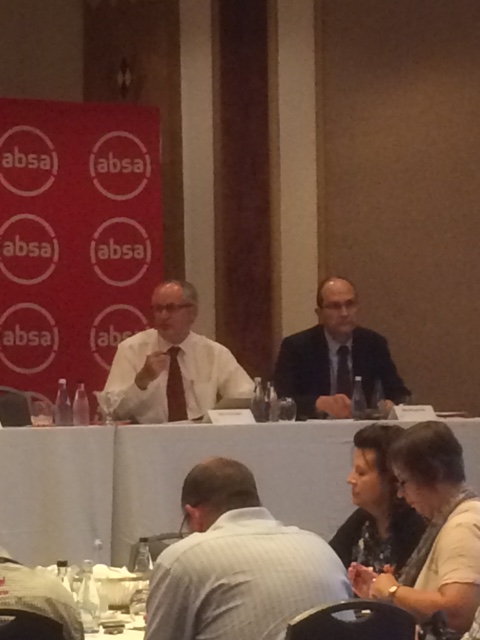
Last week we attended a viewing and discussion on the annual budget speech given by the South African Minister of Finance, Mr Tito Mboweni. The event was hosted in Sandton by Absa Agribusiness and steered very ably by Dr Tobias Doyer. The quests would hear a panel discussion by prominent agricultural economists and role players, prior to watching the Minister's speech on a big screen, followed by an analysis by the same.
Belinda Jacobs opens proceedings

 The speech was viewed as a rather-you-than-me by many commentators as they viewed the country's economic condition [low growth and a subsequent drop in tax collected; and a crisis in the state energy provider (Eskom) among the issues]. The Minister also had to balance what the market and rating agencies wanted against the demands of the trade unions and the government's pro-poor constituency. He appeared with a horticultural prop, an aloe vera (a succulent plant with ornamental and medicinal value). 

The speech has come and gone, along with a plethora of comment (three appropriate ones are listed at the end of this blog). The issues raised by the panel remain, and we hold them up here as a yardstick to measure what transpires during 2019 and beyond.

Dr Tobias Doyer keeps the audience part of the discussion.


Grow the markets

Deal with the restraints. Get growth and investment happening in agriculture. Sort out market access issues: make trade easier. When trade happens, you (government) get more taxes. 

Export-led growth is the way to go. It makes for a healthy trade balance and creates jobs.


Biosecurity

This is a trade issue. The challenge here is to increase the capacity of staff responsible for biosecurity and the efficacy of vaccines. The importance of zoning and compartmentalisation means that the integrity of agricultural operations is maintained.
Dr Tinashe Kapuya provides his analysis. To his left is Dr Langa Simela.


Small business development

Dr Tinashe Kapuya catches an audience's attention by saying that the USA supports failures. And then makes his point. Quoting statistics that show the high percentage of new businesses that fail, he says that to keep going despite failure increases the chance of success; that the door must not be closed.

For small holder /new farmers, security of tenure and developmental finance are crucial.
 

Research and development

The 4th industrial revolution (4IR) requires a science-based education. Education in the country -- particularly basic education -- needs upgrading, attention and resources. 

The country will succeed in the 4IR if the private sector is included and assisted. A member in the audience motivated strongly for creating a platform for overseas-based and other businesses to do research and development here.


Energy

Energy is probably the single biggest issue facing economic growth. Changing the regulatory environment will allow changes in Eskom. This does not equate to privatisation (anathema to the unions) but will make it easier for private providers of energy to supply the grid. These providers have already created jobs and massive investment.  
Dr John Purchase (Agbiz) and Mr Wessel Lemmer (Absa)


Social stability and inequality

Agriculture makes social stability possible but also depending on the same social stability.  

Maintaining the funding of education, health and grants keeps the crisis of poverty and inequality in check, but must be balanced with growth.


Water

There was not much on this at all in the budget speech -- unless you take into account capacity building measures for local government (who are perhaps the biggest threat to water quality in the country)! Irrigation agriculture, as the country's largest user of water resources, also needs to do more with less. 


Some budget commentary:


Thursday, 24 January 2019

Biofuel production in sub-Saharan Africa should be prioritised for aviation

Press release

Pretoria (23 January 2019). A new report has found that while there is a small but not insignificant potential for the production of sustainable biofuels in sub-Saharan Africa, this should be prioritised for the aviation industry which has limited other options when it comes to reducing carbon emissions.

It’s estimated that by 2050, global aviation could account for over 22% of all global carbon dioxide emissions due to rapid growth in air traffic – and with limited operational and aircraft design options for reducing emissions, there is a need for more low-carbon fuels.

The WWF report, titled “Taking off: Understanding the sustainable aviation biofuel potential in sub-Saharan Africa”, looks into the current and future potential of biofuel feedstock production in sub-Saharan Africa using the strict sustainability criteria of the Roundtable on Sustainable Biomaterials (RSB) standard.

These criteria exclude any crops and biomass residue which would result in negative environmental and social impacts, such as food insecurity, unsustainable use of scarce resources like water, land, the destruction of biodiversity and insufficient reduction of greenhouse gases.

Among the key findings are:
  • Sub-Saharan Africa could at best contribute between 30% and 90% of long-term alternative aviation fuel demand in the form of RSB-compliant aviation biofuel produced from energy crops on approximately 84 million hectares of prime and good quality land and another 157 million hectares of moderately suitable land.
  • This assumption holds that ALL energy crops on suitable land in sub-Saharan Africa would be reserved for the exclusive production of biofuels for aviation.
  • The highest greenhouse gas (GHG) savings are typically achieved by perennial crops. To incentivise farmers to invest in the cultivation of such crops, the aviation industry and fuel suppliers should sign long-term off-take agreements to mitigate the risks related to their production.
  • Annual energy crops could be planted on degraded land (such as the rehabilitation of mining land) and could replace other industrial crops in decline. An example would be replacing tobacco crops for the cigarette industry with Solaris tobacco which is a tested feedstock for biofuel.
  • Because shipping feedstock long distances could reduce the GHG savings, the finished product should ideally be processed locally to develop a local biofuel value chain and industry.
QUOTES

Tjasa Bole-Rentel, WWF’s Bioenergy Programme Manager:
Ambitious targets are being set for biofuels around the world, both for land transportation and aviation, without a good understanding of how much we can produce sustainably. Such estimates are not possible without looking at the bigger picture of land availability and its agro-ecologic suitability for the production of energy crops in the context of all competing land uses for food, feed and nature conservation. This study sheds some light on what is realistically possible in terms of biofuel production in sub-Saharan Africa without compromising the region’s food security or critical ecosystems, so that we can set realistic targets and provide the right incentives to maximise the opportunities and minimise the risks of large scale biofuel production.

Rolf Hogan, Executive Director, Roundtable on Sustainable Biomaterials

As the aviation industry looks to ensure its long-term sustainability and comply with climate mitigation measures, the question of where these feedstocks and fuels are going to come from is becoming increasingly relevant. The industry needs to know that it can procure alternative aviation fuels that can demonstrate real greenhouse gas emission reductions and that don’t negatively impact on social and environmental sustainability. This report, supported by Boeing, proves that sub-Saharan Africa can play a major role in decarbonising the aviation sector, and that this can be done really sustainably and without impacting food security, land rights, water rights, conservation areas and more. There is a huge opportunity for responsible and sustainable economic growth on the continent to support the long-term viability of the global aviation industry. It shows that the potential is there in Africa and, with the right investments and incentives, that potential can become a game-changing reality.

Dr Sylvia Tramberend, International Institute for Applied Systems Analysis
The transition to a low-carbon economy with biomass as one of its energy sources will intensify the energy-agriculture linkage and add a new dimension to agricultural systems, heighten resource competition in the food system, and may provide new opportunities for rural communities. As food, feed and energy feedstock markets integrate more closely, both challenges and opportunities arise. Increasing biofuel feedstock production in sub-Saharan Africa, while at the same time meeting food demand targets and strictly following sustainability principles, faces a high degree of complexity. Integrated system analysis such as this helps unpack those complexities and will hopefully contribute to a better informed debate and policy development on the topic.

Download the full report here: www.wwf.org.za/report/taking_off

Contact: Alexis Scholtz-Wheeler ascholtz@wwf.org.za