Wednesday, 29 November 2017

Famous Brands Cheese company and Coega Dairy empower communities with cash for cows

Famous Brands Cheese Company (FBCC) and Coega Dairy will collectively contribute R3 million to five black-owned community dairy farms in the Eastern Cape to finance the purchase of more than 300 dairy cows. The funds will be disbursed over a three year period, with FBCC and Coega Dairy each contributing R1.5 million.


L Collet (Coega Dairy), Mr. L Kente Ncora (Dairy Trust), Ms. L Maso (Seven Stars Dairy Trust), Mr. C Jantjies (Middeldrift Dairy Trust), L Mavhungu (Fort Hare Dairy Trust), Ms. F Ngqakayi (Shilo Dairy Trust), Mr. J Every (Amadlelo Agri), Ms. L Nthla (Famous Brands)
In 2016, Amadlelo Agri, a black empowerment agricultural business which manages the five community owned farms, approached Coega Dairy and FBCC to assist local community farmers to attain ownership of their own dairy herds.

Andrew Mundell, Famous Brands’ COO Enterprise Development, says, “At present, a large number of the cows on the community farms are leased from commercial dairy farmers. By investing in this project we will assist the community farmers to gain increased access, participation and ownership in the value chain.”

He adds, “Ensuring security of supply of raw milk is critical to FBCC and Coega Dairy, and this investment will achieve that. The farms currently deliver approximately 25% of FBCC’s total milk intake. It is projected that the cows and their future offspring will produce in excess of 10 million litres of milk over a five year period.”

The five community farms which will benefit from the R3 million investment are: Fort Hare Dairy Trust, Middledrift Dairy Trust, Keiskammahoek Dairy, Shiloh Dairy Trust and Ncora Dairy Trust.

Coega Dairy was founded in 2011, and is a processor of dairy products and one of the largest long life milk producers in the country. This unique business was established through the partnership of existing commercial farmers with previously disadvantaged communities. The Dairy procures milk from producers in the Eastern Cape and processes UHT milk and butter at its modern facility in the Coega Industrial Development Zone in Port Elizabeth. The Dairy’s products are sold nationally through retailers and wholesalers.

FBCC was established in 2012 when Famous Brands entered into a ground-breaking joint-venture partnership with Coega Dairy, which is co-owned by local farmers, and factory and farm employees, to supply cheese products to the Group. FBCC is co-owned by Famous Brands (51%) and Coega Dairy (49%). The shareholders in Coega Dairy are milk producers (62%) and the Coega Empowerment Trust (38%). The beneficiaries of the Empowerment Trust are the five black-owned community farms (40%), factory workers (40%) and farm workers (20%).

 FBCC comprises a state-of-the-art cheese manufacturing plant, situated adjacent to Coega Dairy’s facility. FBCC procures its milk requirements from Coega Dairy which it then processes to produce Mozzarella, cheese slices, cheese spread and cream cheese for the Group’s franchise network. The plant processes nine million kilograms of cheese products per year. Together the businesses employ 275 people.

Mundell comments, “We established FBCC to further our strategy to build the Group’s manufacturing capability and leverage opportunities in the supply chain. The business has been a tremendous success. Over the past five years the intake of raw milk at Coega Dairy has increased by 14% per annum while milk intake for cheese at FBCC has increased by more than 20% over the past four years.”

Victor Korsten, Chief Executive of Coega Dairy, says, “Coega Dairy and FBCC are committed to the development of this primary production of milk from community farms and this locally focused empowerment investment will make an important difference in a particularly needy province.”

He adds, “All the necessary operational, technical and statutory support will be provided to ensure the sustainability and good governance of the project.”

Mundell concludes, “We are excited about the opportunities this investment will create for local community suppliers, while ensuring we continue to meet our franchise network’s growing demand for this strategic menu item.”

Written by Instinctif Partners Africa.

Find the Dairy (cattle) and Dairy processing chapters in the Agri Handbook

Monday, 20 November 2017

Going, going ...


We came across an infographic by TuskPhoto recently: a list of 10 endangered African species.

Some of these species are covered in the “Wildlife on farms” and “Birds and farming” chapters, and are central to programmes run by groups like the Endangered Wildlife Trust. Included here are the riverine rabbit (less than 250 adults left), the cheetah and the African white-backed vulture.

White and black rhino are on the list. Since the 70’s they have been intensively poached. Northern white rhinos were declared “extinct in the wild” in 2011, and only three individuals are left on the planet. Rhino horns are used in Chinese medicine to treat a variety of health issues. Other countries that buy rhino horns are South Korea, Taiwan, and Vietnam. While the governments of these countries do not take action the poaching will continue.

Other animals on the list are the Ethiopian wolf (only wolf species found in Africa), the African elephant, the Mountain Gorilla, the African Penguin and the African Wild Dog.

The infographic contains pictures of these ten species along with short notes on the reasons for their dwindling numbers in the wild.

TuskPhoto run wildlife photography tours and safaris.


Friday, 8 September 2017

The importance of feeding on rotting meat

It is with great sadness that we read about 45 vultures being poisoned this week, ironically the week after International Vulture Awareness Day. That it happened in neighbouring Mozambique is immaterial. The sun shines, rivers run and vultures fly as they have for centuries. Nature does not recognise the compromise of the geo-political boundaries that we have drawn.

Of course, borders and the right protocol around them are important in as far as biosecurity goes. It is vital to keep in check the pests and diseases that rise like shadows from the way we live and farm. Biosecurity guarantees economic sectors, livelihoods and interlocking economies, and is necessary, it goes without saying. The Food and Agricultural Organization of the United Nations lists issues like transboundary pests and diseases, exacerbated by our changing weather patterns, as trends that the planet will have to face while its farmers produce food for its 7 billion plus humans (find its The future of food and agriculture: trends and challenges, released this month here).

Vultures are listed as one of the beneficial birds in our "Birds and farming" chapter. Their digestive systems mean that they can absorb cholera, rabies and prevent disease from spreading, and play a critical role in maintaining the ecological health of the planet.Unfortunately they are one of the fastest declining groups of animals in the world. 

In the end, the poisoning of these vultures this week is part of a wider problem. Would that there had been other ways for the human beings who laid out the poisoned meat to have been earning their keep! While we stumble forward and look for solutions, allow me to remember the 45 vultures for whom any enlightenment will have arrived too late.


Sunday, 13 August 2017

Those agricultural metaphors

We have spoken before about how agriculture not only provides the food we eat but also supplies some choice, apt metaphors, usable by people of every persuasion.

It was my seeing the headlines in the morning newspaper email which diverted me from the usual Sunday morning routine. Man charged with murder after driving his car into anti-right wing protesters. No, not in Europe, nor someone of Middle Eastern or North African origin: an incident in the USA, and a car driven by a full-blooded American.

Of course it is our view (admittedly an outsider's one) that the decision to remove a respected confederate general's statue was an unnecessary one. By all means stomp on individual aberrations of misplaced patriotism when these appear, but the wisdom of trying to excise a part of your own history ...? Americans should be able to speak of "our General Robert E. Lee" (and "our Frederick Douglass") in addition to "our Ulysses S. Grant".

The Virginia governor, we  hear, "told white supremacists to go home". The USA is home, or is Virginia not part of the USA?  There is a danger when we don't integrate what is part of us and make it an over there. It is the fault line of how a large portion of adherents interpret their religion ... and the religion of others. And so only members of another faith drive motor cars into people.

Trump has responded by telling Americans to “love each other, respect each other and cherish our history and our future together. So important. We have to respect each other. Ideally, we have to love each other.” The words are true, of course, but does this man have the right to say them?  A man who pushed every fault line to come up as president?

There are no short cuts to integrity. This is a bank account you must build (and lose) yourself: it cannot be inherited from another. The irony of the richest ever president and his cabinet of billionaires not possessing the moral capital to make a difference! In a world where fear creates every division, every us-them, leadership calls for individuals comfortable with the divides in their own selves to stand as figures of unity in their countries, especially when these countries have diverse populations. When a leader like that is not forthcoming, that country has a harvest to reap.

Monday, 7 August 2017

On BFAP Agricultural Outlook 2017 - 2026: applause, opportunities and warnings


The latest annual Bureau for Food and Agricultural Policy (BFAP) Baseline Agricultural Outlook has been released.

The annual Outlook is a project among several role players, primarily driven by the University of Pretoria, University of Stellenbosch and the Department of Agriculture in the Western Cape. It is at pains to stress that the Outlook is not a prediction, merely a look at what is possible should various factors remain constant.

It notes some good news:

  • The intensive livestock production enterprises will benefit from the surplus of grain following the ending of the drought in most areas of the country (the negative, of course, is low producer prices for grain farmers). 
  • The country has for the past five years been a net exporter of beef. This is a positive even if a lack of weaners following the drought means that weaner prices are higher.
  • Lamb and wool prospects look good.
  • Growth in horticultural products such as berries, macadamias and pecan nuts continues to be “phenomenal”.
A round of applause, please, for the country which has, since 2005, reduced the percentage of the population living in the low income brackets (LSM 1-3) from 32 percent to 8 percent. It follows that this has led to a greater demand for food, and particularly to what is eaten.

The above growth is projected to slow down “considerably” over the next ten years, however, and be concentrated in urban areas. The BFAP Outlook suggests that this fact, along with the disparity between urban and rural prices, creates “significant opportunities” for informal chains to expand. Any entrepreneurs with ideas on how to close the gap between urban and rural food prices?

Higher income earners look for healthier alternatives (as well as value for money options). This is to be seen as an opportunity.

“Well-structured trade agreements, market access, and well structured and well managed sanitary and phytosanitary regulations” are what government must bring to the table.

Investment in the maintenance and expansion of water infrastructure, producer support programmes and education and training are top priorities for public sector funds.

All eyes are on the Western Cape, a major producer of horticultural products and wine. The spectre of drought has not been lifted here. And innovation among grain producers is a necessity: they should look at ways to add value to their product and/or to dilute margins in order to survive.

Access to support services like finance, information and technology, and economies of scale and the ability to manage risk “will count more than ever”, be it for commercial farmers or developing ones. Role players in the value chain who are not competitive or highly efficient, or not “positioned correctly in terms of their value add to the chain” will probably not be around next year.

Warnings

The Outlook reminds us that producers in South Africa are among the lowest five countries in the world when it comes to receiving subsidies from government [OECD’s Producer Support Estimate (PSE)]. Taking this into account, along with current economic condition, the targets of the National Development Plan are “simply not achievable”.

There has to be a belief that there will be growth before the necessary investment in agriculture happens. Improving food security, creating jobs, creating wealth (and reducing poverty) all depend on this. The mixed messages from government and resulting “increasing political uncertainty” keeps the brakes on this necessary belief in the future.

The implications for land reform and developing producers are significant. The industry as a whole needs to put realistic targets and plans in place, and then jointly execute these plans. A fragmented, ideologically driven, and uncoordinated approach will fail.

The success of developing producers and land reform will hinge on the ability to allow producers to express their entrepreneurial potential. Simply supporting people without allowing them to thrive and grow through innovation, will not lead to success.

This implies
  • access to cutting edge knowledge and expertise;
  • access to land but with ownership vesting with the producer to allow them to leverage the value of the asset to access finance and to allow them to increase the size of their operations to gain economies of scale;
  • access to cutting edge technology and genetics to allow them to produce proper yields and good quality products that can be sold to both formal and informal markets;
  • and lastly a nimble and supportive government that creates a playing field whereby developing producers and land reform beneficiaries can truly unlock the economic potential vested in themselves and the resources they gain access to.
Dreams of success that do not take into account these realities will remain just dreams.

Source: BFAP BASELINE | Agricultural Outlook 2017-2026

Download the full document at www.bfap.co.za.

Thursday, 27 July 2017

Rustler's Valley (conclusion): Conversations 2


The steps taken by EarthRise Trust in purchasing Rustler’s Valley and setting in motion what has happened since is a conversation on its own. Co-operatives have long been punted by governments worldwide as the vehicle to get the wheels of development turning. Our chapter on co-operatives begins: "Co-operatives are not only for the poor, but of all the different types of business organisations, co-operatives reach down most to the low income groups". And "The main feature of co-operatives is that they help people to help themselves".


Naledi Village Farmers’ Co-operative will face the challenges of all co-operatives because it is a collection of human beings: how to motivate and keep all members motivated and giving their best? How to ensure quality control (in preparing rooms at the lodge, for example)? That they are doing it for themselves will be a reason for many, but not all. Naledi Village Farmers’ Co-operative carries the hopes of the whole village. It holds the potential too of being an example to communities everywhere.

Prayer flags
Another conversation introduced by Rustler's Valley is around security of tenure.
  • How do you strengthen the rights of people working and living on a farm without threatening the farmer’s sense of being control of the land to which he holds the title deeds and to which his life is tied? 
  • How do you balance this with the security of tenure for farm dwellers themselves? It is not only livelihoods that hang in the balance. Some farm dwellers go back some time of farms. Graves of their fathers and mothers are on the property, for example.

The "heart" of social activities at Naledi Village. Below this is a soccer field.
The unintended results of lawmakers in the past two decades have seen numerous farmers moving their staff off-farm. The International Labour Organisation (ILO) report "Farm Workers’ Living and Working Conditions in South Africa: key trends, emergent issues, and underlying and structural problems"  listed in our Labour and agriculture chapter provides an excellent analysis of the situation between farmers and labour, and we won't go into it in details here.

View from a mountain top facing Lesotho. Rustler's Valley is behind the photographer.
When EarthRise Trust purchased the Rustler’s Valley farm, it gave the community who lived on the farm ownership of the land on which their houses stood so that they would never again have to worry about being evicted. It also fenced off 42 hectares for the villagers' own use.

It might be true that this is easier to do something like this if you have property and interests elsewhere, in addition to your farm. Be that as it may, the developments at Rustler’s Valley are an event, a benchmark. The Trust has done its best in terms of the community living on the farm, and this challenges others to do their best too.

"Conversation" points to an engagement of role players, defining a problem with a view to seeking a resolution. Conversation sheds light on existing perspectives, hopes for a consensus/ compromise, and arrives at measures to take a case forward. If no forward movement is possible, at least there is more light on the matter. The resulting understanding of the reality on the ground prepares role players for a potential gap when it does open.

Rustler's Valley is a conversation in itself and one which will lead to many more.


FOOTNOTES

  1. Issues of tenure have featured in AgriBEE which includes a provision for farmers to set off a portion of land for the farm workers’ own use. The Strengthening of Relative Rights for People Working the Land (50/50) Programme, launched in 2015, sees farmers and workers sharing ownership of the farm. The best model we ever came across was the Grasslands Development Trust in the Eastern Cape which ensured 100% black land ownership [find the paragraph on it here].
  2. This month (July 2017) has seen the publishing of two documents on the issue: the Association for Rural Advancement (AFRA)'s Pathways out of Poverty: Improving Farm Dwellers’ Tenure Security and Access to Housing and Services and the Socio-Economic Rights Institute (SERI)'s Protection Against Eviction under the Extension of Security of Tenure Act. Both are hailed as guides for people interested in farm tenure rights. 
  3. Last week saw the Biznews Weekender newsletter pointed to the many farmers who live off-farm, a response to farm attacks, but this is a point for another post.


Rustler's Valley: Conversations 1

The facilities at EarthRise Mountain Lodge are comfortable, and conducive to conversation. Indeed, several happened during our stay.


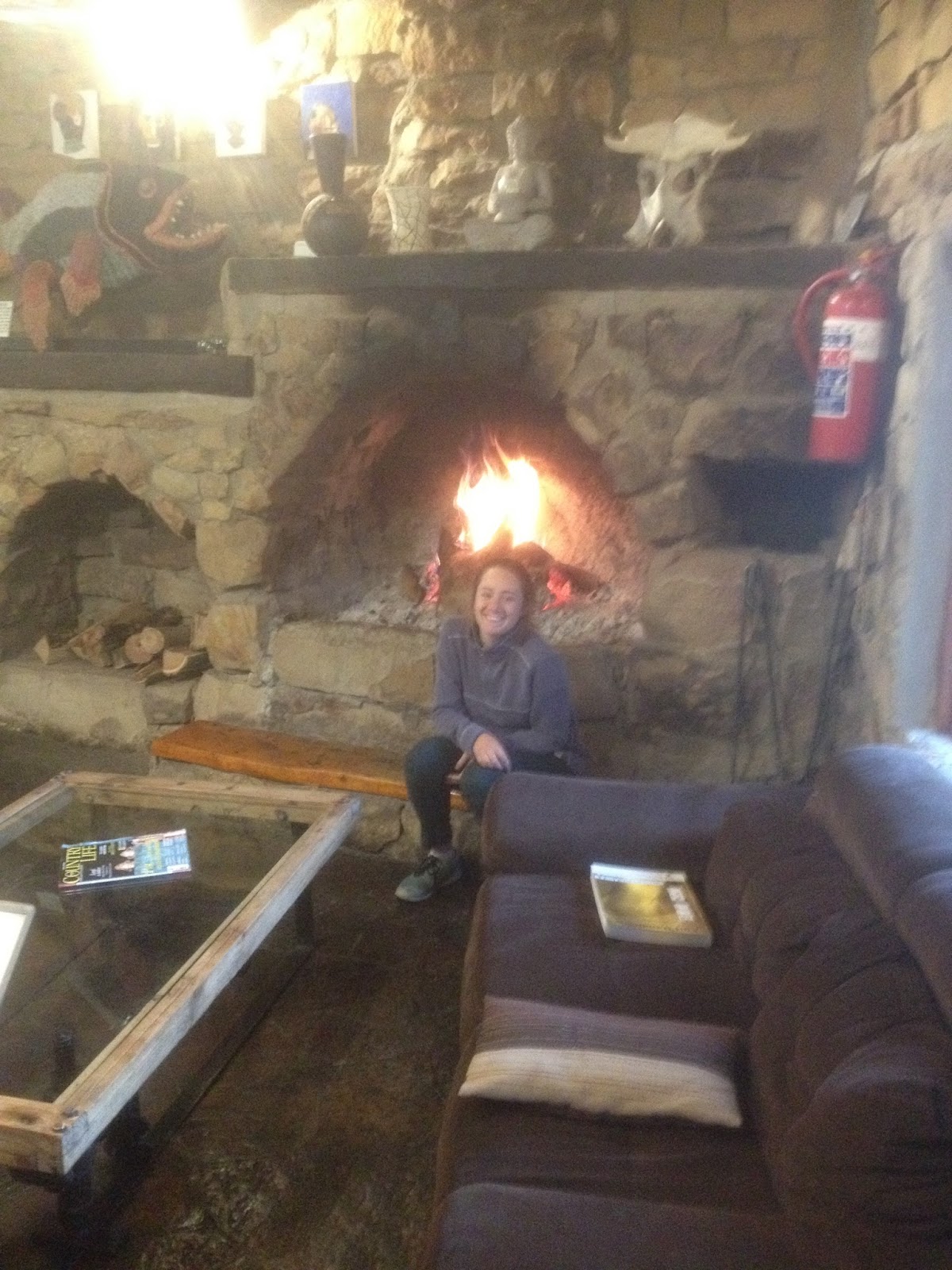
Every time we arrived at the reception, we were impressed by the warmth of those present, a warmth matched by the fireplace, a welcome attraction on cold days and cold evenings. And when people gather near a fire, conversation starts.


We gave an introduction to using the Agri Handbook. There is a proverb, Dikgomo ke banka ya Mosotho (cattle are the bank of a Mosotho), and we smiled widely at the response of Anton Chaka, chairperson of Naledi Village, to being shown the marketing and livestock auctions chapters, watched him nod as he went through the details. The introduction led to a discussion, not only on marketing but on recognising and developing existing skills in the community.

An evening conversation at the EarthRise Trust house. 

Another conversation (which we wish had been recorded) was primarily between Gino and Mike. That Gino champions local government and local development is an understatement. Because South Africa is "only a boundary", a "compromise of 287 municipalities", local government is where the action and potential lies, being the closest to the people. The civic groupings were drawn into government structures in 1994 and ceased to exist. We need to start again. Democracy is not just about voting every five years!

To the discussion Mike brought the value of Blockchain and cryptocurrencies, and the enormous potential they hold for people at grassroots level. [There are several videos on YouTube about this. Watch "19 industries the Blockchainwill disrupt" for example, or the TED talks]. It was a fascinating conversation. 

It had been an hour plus and some of us slipped out: we wanted to snap some last photographs and to catch the sunset.